Tata Motors to M&M, weak rupee squeezes margins for electric vehicle makers

Taking into account that the localisation level in most of these vehicles is low, at less than 50 per cent, the impact of a weak rupee is high due to high import content

Tat Motors MD and CEO Guenter Butschek
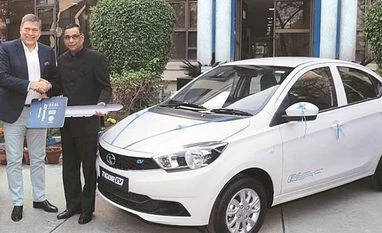
Tata Motors MD and CEO Guenter Butschek (left) delivering the first batch of Tigor EV to EESL MD Saurabh Kumar in December 2017
Ajay Modi New Delhi
4 min read Last Updated : Aug 05 2019 | 2:33 PM IST
The sharp and unexpected depreciation of the rupee (against the dollar) has come as a shock to the domestic electric vehicle industry, especially companies such as Tata Motors, M&M and BYD-Goldstone, which won large orders in tenders for electric cars and buses.

These orders were awarded between September 2017 and February 2018, when the Indian currency was stable at around Rs 65 against the dollar. It has depreciated by over 11 per cent since then. Supplies of these vehicles are being done in a phased manner and are yet to be completed.

Taking into account that the localisation level in most of these vehicles is low, at less than 50 per cent, the impact of a weak rupee is high due to high import content.

Consider Tata Motors’ Tigor electric car, which has a localisation of around 40 per cent and was finalised at Rs 1.016 million (excluding the goods and services tax) for supply to Energy Efficiency Services Ltd (EESL) last year. This means that components worth about Rs 600,000 (including the battery) are imported and are exposed to forex risk. A depreciation of 11 per cent means the cost of imported content surges by another Rs 66,000, leading to an increase of more than 6 per cent in the overall cost of the vehicle.

These contracts do not have a clause for any price revision.

Tata Motors says there will be an impact owing to rupee depreciation. “We made certain assumptions to the best of our knowledge in the tenders. We are committed. There are certain changes in the overall picture like the exchange rate. It is in the nature of the business, which is never risk-free. That puts some pressure but will focus on ongoing cost reduction. This is an additional trigger for the need to have local batteries for EVs,” the company’s Managing Director and Chief Executive Officer Guenter Butschek told Business Standard early this month.


Tata Motors had also won orders for 190 electric buses from state transport entities. The lowest price of these buses is about Rs 7.7 million.

Tata Motors had made aggressive bids in the EESL tender and had emerged as L1. M&M, which had been operating in the EV space for a number of years, was L2 and later decided to match Tata Motors’ price to supply the e-Verito. The company had stated it would not make any money on these supplies. Clearly, the exchange rate means the company will make a loss on these orders. M&M did not comment on the impact of a weaker rupee on the EV order from EESL. It is selling 5,000 of the 10,000 e-vehicles to EESL and the rest is being supplied by Tata Motors.

“Nobody expected the rupee to depreciate to these levels. So while manufacturers may have hedged for the currency risk, there is bound to be an adverse effect on the prices of imported components and hence an erosion of margins. While the exact net localisation content including child parts is not known, it is expected that the import content would be enough to cause a noteworthy adverse effect,” said Ashim Sharma, partner and group head at Nomura Research Institute (NRI) Consulting.

BYD-Goldstone, which has orders to supply 290 buses, will also take a hit. Goldstone, the Indian partner of Chinese EV major BYD, recently renamed the company Olectra Greentech. The company declined to comment on the impact of exchange rate on margins.

Losing charge
 
  • A depreciation of 11% in rupee is squeezing margins for Tata Motors, M&M, and BYD-Goldstone
  • These companies had won orders to supply e-vehicles when the currency was at 65 per US dollar
  • Tata Motors is selling 5,000 e-Tigors to EESL and 190 e-buses to state transport firms. M&M is also selling 5,000 e-Veritos to EESL 
  • e-Tigor and e-Verito production cost is estimated to have surged up to 6% because of weak rupee

One subscription. Two world-class reads.

Already subscribed? Log in

Subscribe to read the full story →
*Subscribe to Business Standard digital and get complimentary access to The New York Times

Smart Quarterly

₹900

3 Months

₹300/Month

SAVE 25%

Smart Essential

₹2,700

1 Year

₹225/Month

SAVE 46%
*Complimentary New York Times access for the 2nd year will be given after 12 months

Super Saver

₹3,900

2 Years

₹162/Month

Subscribe

Renews automatically, cancel anytime

Here’s what’s included in our digital subscription plans

Exclusive premium stories online

  • Over 30 premium stories daily, handpicked by our editors

Complimentary Access to The New York Times

  • News, Games, Cooking, Audio, Wirecutter & The Athletic

Business Standard Epaper

  • Digital replica of our daily newspaper — with options to read, save, and share

Curated Newsletters

  • Insights on markets, finance, politics, tech, and more delivered to your inbox

Market Analysis & Investment Insights

  • In-depth market analysis & insights with access to The Smart Investor

Archives

  • Repository of articles and publications dating back to 1997

Ad-free Reading

  • Uninterrupted reading experience with no advertisements

Seamless Access Across All Devices

  • Access Business Standard across devices — mobile, tablet, or PC, via web or app

Topics :Electric Vehicle

Next Story




