There are many reasons why Jack Ma has chosen Paytm over other companies to invest about $575 million in. For one thing, Paytm, a brand of One97 Communications, is growing faster than expected. For another, it has innovatively intermixed different business platforms with technology to get the maximum out of them.
The company, primarily known for its mobile wallet, has already amalgamated e-commerce with its wallet platform, which works as a marketplace. This ensures better income, as the transaction fee is about four times what it earns from the mobile wallet business for facilitating transactions.
Paytm earns about 1-1.5 per cent as transaction fee from its mobile wallet business, while from the mobile-commerce business it earns up to five per cent. It has about 10,000 offline and 16,000 online merchants registered on its mobile-commerce platform.
Paytm's active user-base of about 20 million, more than the total number of credit card users in India, would naturally be a target segment for Alibaba in India, while the deal does give Paytm a chance to explore China. Paytm's model is very similar to Alibaba's Alipay wallet. With the deal, both companies will be able to leverage their user base and merchants' network in India and China. It has been estimated that India is set to witness internet transactions valued at more than $30 billion annually by 2020, driven by online purchases via smartphones.
Next is Paytm's dream to be part of Indian's financial inclusion programme. The company has applied for a licence to operate as a payment bank. Paytm is likely to use the funds it recently raised to establish the proposed payment bank, enhance its marketplace and strengthen technology and security. If it is granted the licence, Paytm will have to establish a physical distribution network.
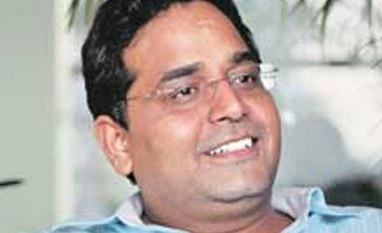
Vijay Shekhar Sharma, chairman and managing director of One97 Communications, has innovative. Instead of establishing a distribution and physical branch network from scratch, he is exploring the possibility of using the retail networks of fast moving consumer goods companies such as ITC and PepsiCo.
Even though technology is a core competence of Paytm, he says that if his company gets a payment bank licence, it will have to buy new technologies to provide banking services. "It would be like a normal bank. So, we'll need additional technologies. We have already started exploring opportunities for potential buys," says Sharma, adding that Paytm may spend upwards of $50 million in acquiring additional technologies over the next two years.
Besides offering standard banking services, Paytm has plans to offer a bouquet of financial services, such as insurance and investment products, to attract and retain customers.
"The dynamics of the market has changed in recent years. Mobile is no longer a service vehicle restricted to telecom companies. Rather, it is helping society to grow. And it has become a growth engine for every business vertical. We are just riding that," says Sharma.
From 20 million users, Paytm aims to cross the 100 million mark by 2016, and getting into the payment bank business will help the company, says Sharma, adding that more than 40 per cent of its users are currently from tier-II and tier-III cities. Some of its users don't even have credit cards or internet banking exposure.
"Some independent shop-keepers create mobile wallets for unbanked people, using their own credit cards or online banking facilities, while physically accepting cash for the amount they deposit in the mobile wallets," he notes.
The company is planning to invest more than $100 million to establish its payment bank in the first phase, and this will go up as Paytm scales up, says Sharma. "We are looking at a break-even period of three to five years," he adds.
Mobile wallet providers such as Paytm follow a semi-closed model, according to which users load money in the wallets and make payments to only those merchants that have operational tie-ups with a mobile wallet service provider. However, the mobile wallet licence does not allow the company to offer cash-out options that enable users to take out cash from their wallets. Thus, mobile wallet users can only use the deposited amount to pay bills and purchase products. But a licence to set up a payment bank will allow the cash-out option to operate like a standard bank.
One97 Communication was adjudged the most innovative company on the basis of a poll of
Business Standard's senior editors.

 "Technology dividend")


 Connect with us on WhatsApp