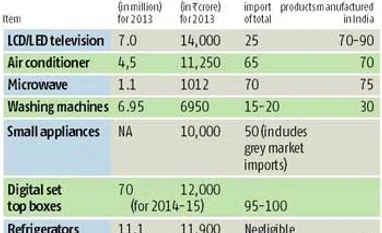
Around 70 per cent of microwave ovens sold in India are imported, mostly from Chinese manufacturers that make these cheap because they make too many. Also, India's duty structure makes microwaves 15-20 per cent cheaper to import than manufacture here. Despite the rupee's recent tumble.
The myth of India's manufacturing prowess shows up starkly in consumer electronics: air-conditioners, television sets, set-top boxes, cameras, music systems, even pencil batteries. According to the Consumer Electronics and Appliances Manufacturers' Association (CEAMA), 30-40 per cent of the over Rs 50,000-crore electronics and appliances sold in India are imported. "Free trade agreements, especially with Asean, the inverted tax structure and lack of government support have led to a surge of imports," says a worried CEAMA secretary-general and a veteran in the business.
He has reason to be worried. Around 65 per cent of all air- conditioners sold in India are imported and those that are not have a large import content. Compressors and indoor units of split air-conditioners are not made in the country. Only LG has a compressor plant here. "We have to import compressors because they are not available in India. Sales volumes in India do not warrant setting up compressor plants," says Shantanu Das Gupta, senior vice-president of Whirlpool India. He points out that compressors constitute a quarter of the bill of materials for an air-conditioner.
Every second television set sold in the country has an LED or LCD panel, and a quarter of these are imported. Sony, which has off and on talked about manufacturing display panels in India, prefers to import these from its facility in Malaysia. Under a free trade agreement with the country, Sony has to pay a mere three per cent duty. "Manufacturing here is not viable," says Kenichiro Hibi, managing director of Sony India.
Even those companies that assemble flat panel television sets in India add only 30 per cent value locally. The most expensive bit of these sets is the display panel, which has to be imported because there are no manufacturers in India. "While 95 per cent of our LED (panels) are assembled in India, 85-90 per cent of the components have to be imported because these are not available here," says S Manish Sharma, managing director of Panasonic India.
A television manufacturing company executive says it takes $1 billion to set up a display panel plant, and technology is moving fast. It makes little sense to set up a plant in India because the market is not big enough. He gives the example of an Indian picture tube manufacturer that decided to invest in plasma technology just around the time these television sets were being phased out globally.
One reason for a weak component industry is the size of the market. In 2013, only 1.3 million microwave ovens were sold in India, for just over Rs 1,000 crore. Only two-three per cent of Indian households have air-conditioners.
Also, the government has made no effort to encourage local production. Domestic microwave manufacturers recently petitioned the government to allow them to import five key components at zero duty, instead of 7.5-10 per cent. In return, they promised at least 70 per cent of the ovens in the country would be made in India. But their proposal has met with silence from the government.
The commerce ministry has moved a proposal for a free trade agreement with China. That, say Indian consumer electronics companies, will cripple local production. China's scale in manufacturing allows its companies to charge rock-bottom prices and could flood the Indian market. "Even Japan gave protection to its consumer electronics industry. But India opened it through free trade agreements and is now also thinking of China. The smaller companies will import. We, of course, have global operations, but the LCD panels that we make in India have 80 per cent imported components," says Venugopal Dhoot, chairman of Videocon Industries.
In some areas, a nudge from the government would have helped. For instance, India's broadcasting industry projects that the country will need over 75 million set-top boxes. Yet nearly Rs 12,000 crore will be spent on importing these from China, Taiwan and South Korea, among other countries. Local companies can make the boxes and match the Chinese price. But they must pay 12.5 per cent as value-added tax, which importers do not. Set-top box makers have petitioned the government but have had no response.
The issue is more acute in the Rs 10,000-crore home appliances market, dominated by small players that manufacture for large brands. As much as 30-40 per cent of components here are sourced from the grey market without paying duties. The government has not been able to stop the proliferation of the grey market. This is not only killing small appliance manufacturers but also the component industry that supported them.
India has become a dream market for electronics and appliance manufacturers as consumers splurge on television sets, refrigerators and air-conditioners. It is already Sony's fourth largest market worldwide, a target LG also hopes to meet. Yet, that growth is heavily dependent on imports, of finished goods and components.

 "Trade pacts queer pitch for electronics, appliance makers")

