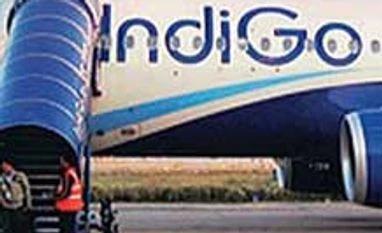
Last fortnight, IndiGo Airlines, the country's largest low-cost carrier, announced a fivefold increase in net profit to Rs 787 crore for 2012-13. Rivals Jet Airways and SpiceJet together made a loss of over Rs 671 crore in the financial year. This was IndiGo's fifth straight year of profit, while the industry lost Rs 46,000 crore in the five-year period. Data compiled by the Centre for Asia Pacific Aviation shows IndiGo has made cumulative profit of Rs 2,200 crore in the last five years. In the period, Kingfisher Airlines went belly up. State-owned Air India, despite the infusion of fresh equity from the government and a slight improvement in performance, is still struggling.
The huge profit for 2012-13 happened in spite of adverse market conditions. Fuel costs went up 13 per cent, the rupee weakened 7 per cent and domestic traffic decreased 3.4 per cent in 2012 over the previous year. The only good news is that the price war has ended, at least for the time being. So, how did IndiGo report so much profit? Aditya Ghosh, IndiGo's low-profile CEO who entered the industry accidentally as a legal counsel to the airline, makes it sound simple: "We increased revenues because of capacity expansion, improved yields, increased efficiency and contained costs; and there were no major fare wars last year."
That might sound simple but, as most aviation experts will tell you, it is difficult to implement on the ground. Ghosh and his team took a calculated gamble: they followed a contrarian strategy last year amidst the slowdown and increased capacity and introduced new flights in order to get more passengers. The airline increased its capacity by over 39 per cent, even while the total industry capacity fell by 4 per cent. On top of that, IndiGo did some deft route planning that helped it gain market share and also contain costs. To explain in simple terms, Indigo has a fleet of 70 aircraft, yet it flies to only 29 domestic and four international destinations. In contrast, SpiceJet has 56 planes but it flies to 45 domestic and 10 international destinations. Thus, IndiGo's strategy is to provide more capacity on select routes, rather than spread itself thinly over several. As each destination requires new investments (rentals, staff, ground-handling, equipment et cetera), this helps contain costs. "It is better to have six flights from one existing destination than one flight each from six new destinations," says an aviation analyst.
Deft planning It also helps to capture the local market better. For instance, IndiGo has connecting flights to four destinations from Ranchi: Delhi, Patna, Mumbai and Bangalore. It now wants to add Kolkata and Raipur to the list. "The strategy ensures that a traveller from Ranchi will not have to look at a non-IndiGo flight to go to any of these destinations. So he becomes a loyal customer and IndiGo gets a larger share of the Ranchi market and adds new customers," says the analyst. Those in the know say cost-consciousness is reflected in the fact that it will not go to a new destination until it can fly from there to at least four different cities and amortise costs. IndiGo carried 27 per cent more passengers in the domestic skies last year, while the industry carried 5 per cent less, and added only one new destination in the whole year but flew more flights from existing cities.
The strategy has worked so far. IndiGo was able to increase the passenger load factor by six percentage points, and increase its domestic market share of the domestic skies from 22 per cent in 2012 March to 28 per cent in 2013. The other key cost is maintenance and spares which constitute about 10 per cent of the operational costs. The strategy is to ensure that the aircraft don't stay grounded for too long because they make money only when they are in air. That is why it has signed up "power by hour" agreements with vendors under which it pays for every hour the aircraft flies; in return, the vendors provide full spares and replacements whenever they are required.
The strategy helps in two ways. One, IndiGo doesn't have to maintain a large inventory of spares or engines. Two, its aircraft are not grounded because some spare parts are not available - that is something the vendors have to worry about. That is reflected in the fact that its technical dispatch reliability of 99.4 per cent is amongst the best in the world. The third advantage, according to Ghosh, is that it prevents the airline from shocks (like a sudden problem in the engine requiring replacement). Aviation experts say the difference was palpable in 2010 when Kingfisher Airlines had to ground its aircraft because of snags in the engine, but IndiGo which used the same machine didn't because of the vendor support contracts. Even its C-checks, which an aircraft has to go through regularly, are planned with cost in mind. IndiGo gets these checks done in Sri Lanka, unlike its competitors who send their aircraft to as far as Dubai, Hong Kong, Singapore and Kuala Lumpur. "The advantage is that you burn less fuel to reach Sir Lanka and, since all your planes go to one place, you get a better price," says an industry insider.
There are other aspects too of the cost-control exercise. For instance, IndiGo's employee-aircraft ratio has improved from around 120 two years ago to 100-102 now. In striking contrast, Jet Airways has a ratio of 130, while Air India's ratio is 262. IndiGo closely monitors turnaround time and fixes tough targets: currently it gets an aircraft ready for its next flight in 31 minutes compared to 35 minutes a few years ago. This has helped the airline achieve its target of keeping the plane airborne for 12 hours a day, despite the fact that it has been getting new aircraft on a regular basis. That apart, its fleet consists of one kind of aircraft: the Airbus A-320. As a result, it is required to deal with one set of pilots, spares and engines. This simplifies the process of running the airline and also keeps costs on a tight leash. This is in contrast to a rival like SpiceJet which has two sets of aircraft. IndiGo has shied away from any loyalty scheme for passengers or the temptation to join a global alliance which, Ghosh says, only adds costs.
Fuel burden The biggest cost for any airline is jet fuel; it can add up to 50 per cent of the operational cost and any savings here could make a large difference to operations. IndiGo goes through it with a toothcomb. For instance, when the aircraft lands and comes to a standstill, the airline goes into a detailed analysis of whether it should be on auxiliary power or should it invest in a ground power unit to save fuel costs. "The question is whether you want to burn jet fuel for the auxiliary unit or burn diesel in the ground unit which is cheaper," says an aviation insider. Pilots are put through training on how to save fuel, which includes details of the time they should take to climb to 32,000 feet. "You can thrust the engine and reach the height fast which means high fuel consumption, or you could do it gradually which saves fuel. That is the detailing the airline goes through," points out a source which has closely seen the airline working. Insiders say that the airline preferred not to go for a full-fledged inflight magazine, which would have added additional weight and burnt more fuel, and stuck to a catalogue-size magazine which is lighter.
Its consistent record of profitability has also helped the airline in getting more attractive financing deals to pay for its lease rentals which, according to estimates, are around 20 per cent of the total operating cost. It's an advantage which its competitors who are in the red cannot match. "We have been able to secure the financing for our planes in advance. The single largest factor which drives it is the creditworthiness of the airline because of the five years of profit," says Ghosh.
The whole effort to prune costs and improve profitability doesn't end here. IndiGo is taking more steps. Thus, it has ordered A-320 Neos which are 15 per cent more fuel-efficient and can make a substantial difference to the economics of the game. It is also pushing ancillary revenues to increase cash flows, though this might happen over the long haul. Ghosh says that ancillary revenues have inched up to 9 per cent of the total, an increase of one percentage point, in the last one year. With the government liberalising the policy (allowing airlines to fix baggage and pay more for some seats), it hopes to get a larger share of its revenue from ancillary sources in the days to come. With AirAsia and the Tata-Singapore-Airlines alliance ready to join the battle, IndiGo requires to pull out all the tricks in the bag.

 "What keeps IndiGo's profit flying high?")


 Connect with us on WhatsApp