Home / Companies / Interviews / You have to find newer ways to work together & collaborate: Raji Ramaswamy
You have to find newer ways to work together & collaborate: Raji Ramaswamy
In a Q&A, CEO of Contract Advertising, along with her boss Tarun Rai, who is South Asia CEO of J Walter Thompson, highlights her for the WPP-owned agency
premium
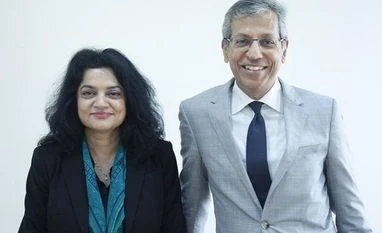
Raji Ramaswamy, CEO, Contract Advertising (Left) with Tarun Rai, South Asia CEO of J Walter Thompson
Raji Ramaswamy took over as chief executive officer of Contract Advertising in July last year. Part of the WPP group, Contract began as the second agency of J Walter Thompson in India thirty years ago and it has grown and evolved since then while continuing to be a part of the group. In this interview with Viveat Susan Pinto, Ramaswamy along with her boss Tarun Rai, who is South Asia CEO of J Walter Thompson, highlights her priorities for the agency. Edited Excerpts:
Where do you see Contract a few years from now?
Ramasawamy: Contract is poised for growth. If we can provide exceptional value to our clients and create new benchmarks in terms of what we can deliver, I think we will achieve our objective. Unlike other large agencies, which have different companies for different services, ours is one agency with an integrated business model. It is part of who we are. My aim would be to scale this up as we move ahead.
Rai: The broad outline as far as I am concerned is that amongst all our companies, Contract is in the sweetest spot. That is because it is of the right size to move to the next level. When agencies are too small, they take time to evolve. And when they are too large, it is difficult for them to move around too much. So, for me, Contract is in the right position to leap ahead. It is already among the top ten agencies in the country, I would like to see it in the top five.
What are the areas you wish to focus upon as CEO of Contract?
Ramasawamy: The first ambition for me is to go out and enter all the big advertising pitches. We can compete very strongly with the larger network agencies because we have the capability to nail the insight. We don’t look at the business and say: What is? We look at the category as well as the business and say: What can be? Even before brand communication, we look at what can we do for the business.
Take Asian Paints, for example, a client we work with. It was a pure paints company, it is now into the decor business. Or Shoppers Stop, a retail store, which has now evolved into a destination that provides a world of shopping experiences. These are just some clients we work with and our strategy has always been this: How can we make a difference to the business as well as the brand and make it stand out in the process.
Contract still carries the legacy of being J Walter Thompson’s second agency in the country. Is there a move to change that and give it a new identity?
Rai: While Contract did start out as an agency to manage conflict clients as a second agency, it is a thing of the past now. You'd be amazed to know that many clients Contract has interacted with in the last few years are not even aware that it is part of the group. It is no longer an agency that simply handles conflict clients. It has its own set of clients that it independently works with and in many pitches J Walter Thompson and Contract actually compete with each other. In my view, Contract has already covered significant ground in having an identity of its own and it can only grow from here.
How is the global network of J Walter Thompson helping Contract in its ambition to grow big?
Ramasawamy: In today's world you have to find newer ways to work together and collaborate. Having access therefore is absolutely key. With the global network, we have that, especially, when it comes to resources. This helps when going into pitches. We can tap into the network's planning, creative and other resources and that is a huge help.
Is India the only market where J Walter Thompson has a second agency structure?
Rai: No. In Latin America, there is a second agency called Santo. It is an acquired agency as opposed to Contract, which was organically created. But the model does exist.

 "You have to find newer ways to work together & collaborate: Raji Ramaswamy")











