What do we really know about India’s largest OTT brand? YouTube reaches 265 million Indians every month, has tens of thousands channels, and made over Rs 2,000 crore in revenues last year. It is two-thirds of the Sun Network or one-third of Zee Entertainment Enterprises in revenues. "YouTube works across most plans as a mass channel especially when layered on TV," says Vanita Keswani, CEO of Madison Media Sigma. Yet it is never mentioned in the same breath as Star, Zee or Viacom18 or Hotstar, Zee5 or Voot.
It should be, for one simple reason. If the worlds of media and technology are colliding to create new players like Netflix or Hulu, then YouTube is arguably one of the biggest plays from the world’s largest media firm — the $137-billion Alphabet that also owns Google. Though Alphabet doesn’t share YouTube’s numbers, analysts estimate it to be anywhere from $8-15 billion in revenues in 2018. Netflix is about $12 billion.
Alphabet dominates not just the US market but the Indian one too, straddling both the TV and digital ecosystem. More than 836 million Indians watch close to 4 hours of TV a day; roughly 550 million of them are also online. At Rs 9,337 crore in revenues in March 2018, Google India is the single largest player in the Rs 16,900-crore digital media market.
Equally, it fights for advertising in the Rs 74,000-crore Indian broadcasting market as the free alternative to TV. Its largest channel globally is T-Series that offers songs, videos, et al.
Now, as broadcasters launch their own OTT brands, many are either pulling out of YouTube or only sharing older library content through it. There were, at last count, about 30 OTTs nipping at its heels. Yet, YouTube continues to grow. “Last quarter, we had the largest/fastest increase in audience for the company. We are constantly looking at how content is scalable towards the N’th million consumer,” says Satya Raghavan, director of YouTube content partnerships, India.
In March came YouTube Music at Rs 99 and YouTube Premium, which offers ad-free content from the brand, at Rs 129-149 a month. During the same period, YouTube started allowing channels to charge membership fees.
These changes came on top of original programmes that it began commissioning towards the end of 2018. “When brands look at us as a large GEC (general entertainment channel) is when a change in mindset will happen,” says Raghavan.
That is where YouTube’s challenges begin.
“Five years ago, there was no way to connect to audiences without a middleman like, say, Karan Johar or Disney. YouTube democratised the content ecosystem,” says Ashwin Suresh, co-founder of Pocket Aces. The 4-year old start-up is now at roughly half a billion views across ITS brands such as FilterCopy or Dice Media. Of these, 200 million come from YouTube.
It has helped thousands of content creators such as Pocket Aces scale up, actively mining categories and genres such as education, lifestyle, kids, agriculture or food, that linear media or even broadcaster-led OTTs can never do.
“The moment a channel hits a lakh or million subs, we step back and see if it can become a vertical. For example, women’s lifestyle is a huge vertical — we never thought of it as women’s lifestyle; we thought of it as beauty. However, we realise it is beauty-plus-lifestyle-plus-fitness,” says Raghavan. There is films, and everything around films. Then there are thousands of YouTube videos that are perpetual favourites. “Everybody wants to know how a dish is made. Videos on how to make a roti are still being watched because that kind of content is timeless,” says Raghavan.
As it has grown over the years, YouTube has become an open digital auditorium where some of the biggest stars and content firms such as Bhuvan Bam, TVF, Pocket Aces or Chu Chu TV first showcased their talent. These have gone on to raise money or become media firms in their own right.
YouTube looks at the market from three axis — consumers, creators and advertisers — and it has a firm grip on all of them. It has every major advertiser on board, promotes content that it sees becoming popular, works hard at helping creators make money on their content, and connects them to fans through YouTube Fanfests.
Yet, there are limitations to being the mothership of all content.
“In India, people like long form content. YouTube doesn’t make it viable, so people go to a Sony or a Voot,” says Suresh. Long form content, say a series, or a film mean more time spent and therefore better rates per thousand viewers.
YouTube shares 40-50 per cent of the ad revenues that a channel makes, with creators.
However, the low rates mean that only really large-scale creators — say a ‘BB Ki Vines’ at 14 million subscribers — can hope to survive on what they make from YouTube. Pocket Aces, for instance, makes a bulk of its money from sponsorships and in-programme placement.
To correct this, memberships were introduced earlier this year. The newly popular Fish Farming channel charges members on how to breed fishes. YouTube does not take a cut on this money.
“It helps creators get fixed income,” says Raghavan. With originals and pay, YouTube could take a shot at the other end of the market, where broadcaster OTTs and independents such as Netflix thrive.
Analysts argue that its real strength remains in being the Walmart of content — there is something for everyone in all languages, genres and geographies. That works beautifully at the mass end of the market, and gets millions of people into the ecosystem. That is the YouTube everyone knows.

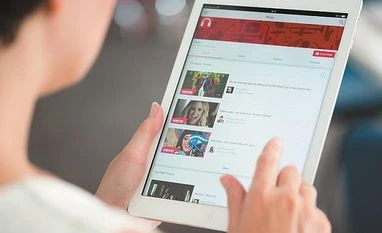 "Walmart of content: YouTube has something for everyone in all languages")












 Connect with us on WhatsApp