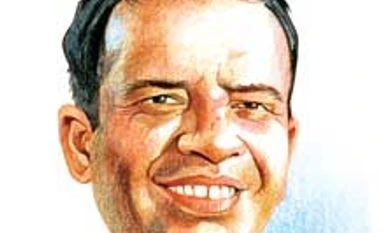
10 things to know about Magsaysay award winner Anshu Gupta of Goonj
Gupta has being recognised for his "creative vision in transforming the culture of giving in India"
Srinibas Rout New Delhi Anshu Gupta, founder of the non-profit Goonj and Sanjiv Chaturvedi, former Chief Vigilance Officer (CVO) at AIIMS have been named as winners of the Ramon Magsaysay Award 2015.
Gupta has being recognised for "his creative vision in transforming the culture of giving in India, his enterprising leadership in treating cloth as a sustainable development resource for the poor, and in reminding the world that true giving always respects and preserves human dignity," a statement from the Ramon Magsaysay Award Foundation said.
Here are 10 things that you need to know about this Gupta, the bridge-maker between rural and urban communities, and his organisation Goonj.
1. Gupta is the eldest of four siblings in a middle-class family from Dehradun. When he was only 14, his father suffered a heart attack, which pushed the teenager into the role of money manager for the family and helping his mother to somehow stretch their meagre resources to make ends meet.
2. A road accident at the end of Class 12 rendered him bed-ridden – botched healthcare because his father refused to pay a bribe has left him with a lifelong pain when he stands for too long – but the yearlong confinement in bed served as a period for reading and introspection. Even then, he started contributing to household expenses by writing articles for Hindi newspapers.
ALSO READ: Lunch with BS: Anshu Gupta 3. He holds a Masters in economics, and a double major in journalism and mass communications. As a graduate student he travelled to Uttarkashi in North India in 1991 to help with relief efforts after a devastating earthquake in the region. This was his first real exposure to the scale of problems of India’s rural masses.
ALSO READ: Lunch with Anshu Gupta 4. The idea of ‘Work for Cloth’ came from a visit to Khooni Darwaza in Delhi once with a so-called ‘body collector’, a person who collects dead bodies of homeless or unidentified persons. “One December night, I accompanied him to collect an unidentified body at Khooni Darwaza. Wearing nothing but a thin cotton shirt, the man had clearly died of cold..." Gupta told Business Standard in an interview. That was when Gupta realised that clothing as a basic human right was often overlooked. In 1999, he quit his corporate job to start Goonj, with only 67 pieces of clothing that his wife and he had collected. "I didn't want to give these clothes as an act of charity. Charity strips people of self-respect," he says. "Thus, the concept of Cloth for Work came into being."
5. Observing the lack of suitable resources at the time of natural disasters despite the abundant supplies from well-meaning donors Gupta’s Goonj works in 21 states across India in disaster relief, humanitarian aid and community development.
6. As the traditional exchange of charity denied dignity to those receiving it. In response, Goonj developed a working system, the Cloth for Work program, which initiates village-level development activities and rewards communities for their labour, allowing them to preserve their dignity.
7. Goonj ships over 70,000 kgs of material a month and has also converted 1,000 tonnes of used clothes, household goods and other urban discards into usable resources for the poor.
8. In 2012, Goonj was chosen by NASA and the US state department as a "Game Changing Innovation" and in the same year, Forbes magazine listed Gupta as one of India's most powerful rural entrepreneurs.
9. In recognition of their important work, Goonj has recently been awarded the Japanese Award for Most Innovative Development Project by the Global Development Fund.
10. Gupta’s pet project is ‘Not Just a Piece of Cloth’. "In villages and slums, where women and girls don't have enough to clothe themselves, menstrual hygiene is really poor. At Goonj, we repurpose old cotton into hygienic pads and use them to generate awareness about hygiene and the myths associated with menstruation," he says.

 "10 things to know about Magsaysay award winner Anshu Gupta of Goonj")

