5 key takeaways from Modi's CFR interaction
Addressing the Council on Foreign Relations in New York the Prime Minister touched on some key issues
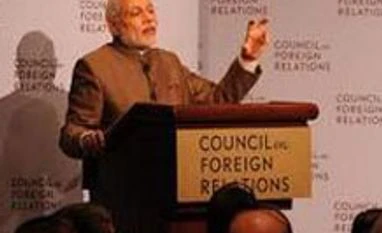
Abhishek Jha Mumbai The Council on Foreign Relations in New York is a powerful and influential policy organization in the United States. Narendra Modi is the sixth Indian prime minister to address the CFR. His speech, however, was a rehash of what he had already said in his trip's first two days at the United Nations General Assembly and then at Madison Square Garden. What was new was the candid question and answer session that followed. Some key takeaways:
The speech highlights: The Prime Minister’s speech combined themes from his first two days in the United States. From
G-All (need to move beyond closed groups like G8 and G20) to 3D (democracy, demographic dividend and demand) formula, Modi mentioned it all. He reiterated that the present century belonged to Asia and China and that India would be at the forefront of it. Modi also stressed on the importance of univocally condemning terrorism. He also defended his government’s stance regarding the trade agreement talks at WTO, saying that he’d keep the well being of the poor section of the society in mind too. He ended his speech by inviting everyone to India and saying that, “Tourism unites, terrorism divides”.
Dynamics with US: With the focus now shifting to Washington D.C. and his meeting with US President Obama, the inevitable question was if the two nations could move beyond posturing and actually start a new chapter in their bilateral relations. Modi had a light and yet serious take on the issue. He said, “One doesn’t have to be comfortable with everything. Even between a husband and wife 100% comfort is not possible but despite that there is long-term commitment.” He added that the fundamental belief in democracy which the two nations shared could go a long way in making each other natural allies.
Terrorism outlook: There was a pointed question on the growing ISIS problem and Islamic fundamentalism. The Prime Minister had a philosophical answer. He said that all terrorism in India is "exported (from outside) and not home-grown". He added that Indians believed in non-violence as taught by Buddha and Mahatma Gandhi. He expressed confidence that the Indian Muslim would defeat the Al Qaeda's designs.
China and the border issue: When asked if the border dispute with China required international arbitration, Modi said that it was not required. He expressed confidence in his government’s bilateral talks with China to solve the issue and added that the process has already begun after his meeting with Chinese President Xi Jinping.
Helping the girl child: The Prime Minister also stressed on the need to address girl child education and said that this was a key focus for him. He added that his cabinet had 25% female ministers and mentioned External Affairs Minister Sushma Swaraj, who was present there, as an example. He claimed that as the Gujarat chief minister he had ensured 100% female literacy and that was his goal for the whole nation now.

 "5 key takeaways from Modi's CFR interaction")


 Connect with us on WhatsApp