Alcohol ban succeeds as women warn, 'behave, or we'll get tough'

Murders and gang robberies are down almost 20% from a year earlier, and riots by 13%
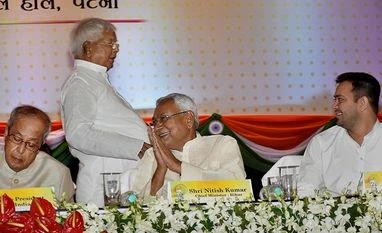
Nitish Kumar, Lalu Prasad Yadav, Tejashwi Yadav, Pranab Mukherjee
President Pranab Mukherjee with Bihar Chief Minister Nitish Kumar, RJD Chief Lalu Prasad and deputy CM Tejashwi Yadav during a felicitation function organised by the Bihar government to mark 100 years of Mahatma Gandhi's Champaran Satyagrah in Patna
Geeta Anand | NYT
Last Updated : Apr 17 2017 | 10:17 PM IST
Dozens of women brandishing brooms swooped down on a straw house in this village on a recent Saturday, sending the owner fleeing through a rice field as they seized buckets of fruit juice being fermented into a cheap liquor.

An hour’s drive away, a group of village women followed the scent of alcohol into a cornfield to find vats of moonshine dug into the ground, which they guarded for several hours until the police arrived.

Like so many disciples of Carry Nation, the temperance advocate who took a hatchet to United States saloons at the turn of the 20th century, village women are taking matters into their own hands, enforcing a prohibition law in Bihar, one of India’s poorest, most agrarian states.

Though per capita income is less than $600 a year, many if not most men used to routinely spend much of their money on alcohol, further impoverishing their families.

“It was the acceptable norm to be drunk,” said Raj Kumar Prasad, the chief of the Halsi police station, which oversees 50 villages, including Bandol.

But that has changed, the authorities and villagers say, adding that the law imposing severe penalties for the sale and consumption of alcohol seems to have worked remarkably well. The crime rate has fallen sharply, government figures show, and spending on things like motorbikes and appliances has risen significantly. And almost everyone credits the vigilance of the women of Bihar for most of the law’s success.

It all began nearly two years ago, when Bihar’s chief minister, Nitish Kumar, was in the fight of his political life against the Bharatiya Janata Party, the party of Prime Minister Narendra Modi. Mr Kumar had just addressed a meeting at a convention hall in July when a woman approached the microphone.

“Brother, ban alcohol,” she said.

For reasons he still cannot quite explain, Mr Kumar said, he pledged, “If I get elected, I will ban alcohol.”

Those words flew onto the front pages of the country’s newspapers, and there was no turning back. The day after he was re-elected, in an overwhelming defeat of the Bharatiya Janata Party, Mr Kumar began drawing up a draconian law imposing maximum sentences of seven years for drinking alcohol and life in prison for making it.

There were no exceptions for medical conditions or tourist hotels — reasons that prohibition had failed elsewhere, he said.

The measure took effect last April. Mr Kumar had planned to enact the law in stages, beginning in rural areas. But protesters prevented liquor stores from opening in the state capital, Patna, even though they were still legal under the first stage of the ban.

The public — particularly women — was energised. Between 200 and 300 complaints a day came in to police hotlines and email accounts, said Alok Raj, who, as the additional director general of police, took the lead in enforcing the law.

Women had long complained that alcohol was impoverishing their families, said Mr Kumar, 66. The results in the year since the measure has been in effect bear those grievances out.

Murders and gang robberies are down almost 20 per cent from a year earlier, and riots by 13 per cent. Fatal traffic accidents fell by 10 per cent.

At the same time, household spending has risen, with milk sales up more than 10 per cent and cheese sales growing by 200 per cent six months after the ban. Sales of two-wheeled vehicles rose more than 30 per cent, while sales of electrical appliances rose by 50 per cent. Brick houses are rising in villages where mud huts used to predominate.

Not everyone is happy. More than 42,000 people have been arrested under the new law and are awaiting trial. The people who made a living turning rice and fruit juice into alcoholic drinks — often the poorest, lowest-caste residents — have been pushed into lower-paying jobs as day labourers. Night life in Patna has been subdued, as many restaurants that used to serve alcohol have closed, their revenue down by as much as 50 per cent.

“The quantum of punishment is too high,” said Jitan Ram Manjhi, a former chief minister of Bihar. “This is unfair.” He supports prohibition but noted that even armed robbery carried a lower sentence.

On a recent afternoon, Mr Prasad, the chief of the Halsi police station, sat at a weathered desk outside his headquarters. A bottle of whiskey stood on the table in front of him as he wrote up a report in Hindi.

That morning, his officers, acting on a tip, had stopped a small white sedan coming from a neighbouring state. Concealed in the doors and other hiding places were 40 bottles of whiskey — evidence, he said, that some alcohol will always be smuggled into Bihar from neighbouring states where it is legal.

60 per cent of the tips he receives are from women, with many even reporting that relatives and neighbour are drinking, selling or making alcohol, Mr Prasad said.

“It’s come into women’s minds, this idea to stop drinking,” he said. “That’s made a big difference.”

In January last year, before the prohibition law was enacted, the women of Bandol made their first collective effort at stamping out alcohol. About 100 descended on a mud hut where liquor was being sold, forcing it to close and dragging the proprietor off to the police station.

Next, groups of women began showing up at the homes of the biggest drinkers in the village, demanding them to stop.

One of the first was Omprakash Ram Chandrawanshi, 35. “Behave, or we’ll get tough,” they told him, recalled his wife, Soni Devi Chandrawanshi. They shouted, “Just like we took that store owner into the police, we’ll take you in.”

Ms Chandrawanshi said her husband had sat quietly, his head lowered, as the women berated him. “I think he thought, ‘If they did that to the store owner, they’ll do it to me,’” she said.

Mr Chandrawanshi, a lean man sitting in a plastic chair outside the room he shares with his wife and three children, said the group had scared him out of a habit that had made him miserable.

“If I earned 500 rupees, I would spend 200 on alcohol,” he said. He earns the equivalent of about $200 a month as a driver, he said, but “I often wouldn’t bring any money home.”

Now, his family is able not only to buy more food, but also to pay for tutorials to help the children in school, he said, and it has been able to expand the brick house shared by the extended family.

So taken were Mr Chandrawanshi and several reformed drinkers with a new, sober life that they have joined the women’s vigilante group in harassing and identifying illegal alcohol operations.

They also answered the call of their chief minister to show their support for the alcohol ban by standing together in a human chain across the state. More than 30 million Biharis, about a quarter of the population, joined hands along 7,000 miles of roadway one day in January, local news media outlets reported.

Mr Kumar’s initiative is so popular among the public that leaders of other states are taking notice. Delegations of state legislators have visited in recent months to study the reasons for Bihar’s success.

The chief minister of nearby Madhya Pradesh State recently announced that he would phase in prohibition. On March 31, the Supreme Court of India reaffirmed its ban on alcohol sales near the nation’s highways to try to reduce drunken driving.

The secret in Bihar is a ferocious law propelled by a relentless social and political campaign that resonates powerfully with women, Mr Kumar said. “Only when you have the women behind you can you succeed,” he said.

©2017 The New York Times News Service

One subscription. Two world-class reads.

Already subscribed? Log in

Subscribe to read the full story →
*Subscribe to Business Standard digital and get complimentary access to The New York Times

Smart Quarterly

₹900

3 Months

₹300/Month

SAVE 25%

Smart Essential

₹2,700

1 Year

₹225/Month

SAVE 46%
*Complimentary New York Times access for the 2nd year will be given after 12 months

Super Saver

₹3,900

2 Years

₹162/Month

Subscribe

Renews automatically, cancel anytime

Here’s what’s included in our digital subscription plans

Exclusive premium stories online

  • Over 30 premium stories daily, handpicked by our editors

Complimentary Access to The New York Times

  • News, Games, Cooking, Audio, Wirecutter & The Athletic

Business Standard Epaper

  • Digital replica of our daily newspaper — with options to read, save, and share

Curated Newsletters

  • Insights on markets, finance, politics, tech, and more delivered to your inbox

Market Analysis & Investment Insights

  • In-depth market analysis & insights with access to The Smart Investor

Archives

  • Repository of articles and publications dating back to 1997

Ad-free Reading

  • Uninterrupted reading experience with no advertisements

Seamless Access Across All Devices

  • Access Business Standard across devices — mobile, tablet, or PC, via web or app

Next Story



