An outdated law ignores health workers' well-being amid Covid-19 pandemic

The pandemic has also exposed the lack of documentation of the state of doctors and paramedics
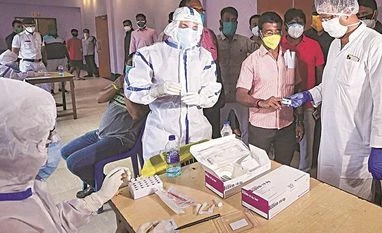
Covid-19 pandemic
The pandemic has also exposed the lack of documentation of the state of doctors and paramedics.
Geetanjali Krishna New Delhi
4 min read Last Updated : Dec 25 2020 | 6:10 AM IST
Circa 1896. Bubonic plague spreads like wildfire in Mumbai (formerly Bombay) leading to about 1,900 deaths a week for the remainder of the year. The Epidemic Diseases Act (EDA) is enacted in 1897 to empower the government to tackle the crisis.

Used to combat the spread of cholera in a Gujarat region (in 2018), deal with dengue and malaria in Chandigarh (2015) and control swine flu in Pune (2009), this British-era legislation is now being used, along with some provisions of the Disaster Management Act, to deal with the coronavirus pandemic in India. Practically unchanged in 124 years, the EDA does not define “epidemic disease”, pertains mostly to ship and land travel, and ignores the implementation of large vaccine drives — a novel concept, like air travel, a century ago. In a pandemic year, the shortcomings of this antiquated law have been starkly felt.

For this series, Business Standard interviewed frontline workers across the spectrum and found that without crucial changes, the country’s response to the pandemic, and indeed to any future health crises, will continue to be flawed.

“Health infrastructure in India is robust on paper, extending to the smallest populations and communities,” says R V Asokan, honorary secretary general, Indian Medical Association (IMA). He and many public health professionals believe that the biggest impediment to a cohesive nationwide approach to the pandemic is that health is a state subject. “We have seen that the fight against Covid depends on actions taken at district level,” he says. “But state governments have responded to it differently. Many have not shared critical district-wise data related to testing, positivity rate, mortality etc, making a national-level effort difficult.”


To address this, IMA has long advocated for an all-India Indian Medical Service. Mooted by the Health Survey and Planning Committee (also known as Mudaliar Committee) in 1961, this cadre would ensure equitable primary, secondary and tertiary healthcare services across the country.

The pandemic has also exposed the lack of documentation of the state of doctors and paramedics. For instance, when Rajeev Jayadevan, president of IMA in Kochi wanted to compile a list of Covid casualties in the medical fraternity across India, in the absence of official data, he had to rely on newspaper reports. “Proper documentation and assessment of the health of doctors is crucial as it will sharpen focus on policies for their welfare,” he says. The same argument can be made for nurses and ASHA workers.

To replace the Indian Nursing Council Act (INCA), the health ministry has finalised the National Nursing and Midwifery Commission Bill, 2020. Nurse activists had hoped this would address some of the lacunae of the old law and set norms for service and patient care; nurse-to-patient ratio, staffing standards; and salaries. However, the Bill remains silent on these. “During the pandemic, several private hospitals cut nurses’ salaries by as much as 30 per cent, while some government hospitals delayed salaries,” says Siju Thomas, joint secretary, Indian Professional Nurses Association (IPNA). Activists say that nurses feel short changed also because they are often excluded from state nursing commissions. “Most decisions about their welfare are taken by doctors,” says Jibin TC, state president of United Nurses Association in Maharashtra.

Nurses and ASHA workers also continue to be dogged by irregular working conditions. “Nurse salaries across the country, and between government and private hospitals, differ widely,” says Roy George, president of Trained Nurses Association of India (TNAI), one of the country’s largest and oldest nurses’ unions. “Why can’t the government set a common minimum salary to protect their interests?”

ASHA workers operate under even more exploitative conditions. “How can the government expect efficient delivery of health services to the grassroots from a cadre of women who have the status of mere ‘volunteers’ and earn barely Rs 2,000-6,000 per month?” asks Vijay Lakshmi of National Federation of ASHA Workers NFAW. “They must receive the government-mandated minimum wage of Rs 18,000 per month.”

The need of the hour is to not only bring in far-reaching legislative changes but to also resolve the workplace issues the health staff faces. “Sometimes, the pandemic feels like a marathon without a definite end,” says George. “By increasing the number of medical and paramedical staff and improving their working conditions, perhaps we can fight the exhaustion.”

Series concluded

One subscription. Two world-class reads.

Already subscribed? Log in

Subscribe to read the full story →
*Subscribe to Business Standard digital and get complimentary access to The New York Times

Smart Quarterly

₹900

3 Months

₹300/Month

SAVE 25%

Smart Essential

₹2,700

1 Year

₹225/Month

SAVE 46%
*Complimentary New York Times access for the 2nd year will be given after 12 months

Super Saver

₹3,900

2 Years

₹162/Month

Subscribe

Renews automatically, cancel anytime

Here’s what’s included in our digital subscription plans

Exclusive premium stories online

  • Over 30 premium stories daily, handpicked by our editors

Complimentary Access to The New York Times

  • News, Games, Cooking, Audio, Wirecutter & The Athletic

Business Standard Epaper

  • Digital replica of our daily newspaper — with options to read, save, and share

Curated Newsletters

  • Insights on markets, finance, politics, tech, and more delivered to your inbox

Market Analysis & Investment Insights

  • In-depth market analysis & insights with access to The Smart Investor

Archives

  • Repository of articles and publications dating back to 1997

Ad-free Reading

  • Uninterrupted reading experience with no advertisements

Seamless Access Across All Devices

  • Access Business Standard across devices — mobile, tablet, or PC, via web or app

Topics :Coronavirushealth workers in IndiaHealth sectorIndian doctors

Next Story


