Artworks by theatre legend Ebrahim Alkazi prove his artistry across mediums

An exhibition of artworks by theatre legend Ebrahim Alkazi confirms his artistry across mediums
weekend
Photo: Art Heritage Gallery
Veer Arjun Singh
4 min read Last Updated : Oct 19 2019 | 12:56 AM IST
A curious, passionate man in his early 20s, Ebrahim Alkazi left his wife and young child to the newfound cosmopolitanism of 1940s Bombay to venture further afield, in search of even more creative shores. He would later come back and help redefine the city’s postcolonial character. But before that, a voyage to London.

“The world had torn itself into pieces and everything was in ruins after World War II,” says his daughter, theatre director and former chairperson of the National School of Drama (NSD), Amal Allana. Amidst the rubble, Alkazi found a basement for shelter, which he shared with the likes of artist F N Souza and poet Nissim Ezekiel, just a few of the other young Indians who would go on to create modern India’s cultural milieu. And thus began a prolific period in Alkazi’s life, which seems too prodigious today to be defined in years.

Photo: Art Heritage Gallery
The world was a terrifying place back then and the struggles were real. The circumstances may have further coloured Alkazi’s vivid imagination, but it was neither the beginning nor the end of his fascination with visual art. He had come to London find an art school that would suit his merit and temperament, but instead rejected them all. The strict nonconformist finally hit his stride at the city’s Royal Academy of Dramatic Art (RADA).

Photo: Art Heritage Gallery
Before he returned to enthral audiences in Bombay, accept the stewardship of NSD in Delhi and dedicate his life to honing artists and have them perform grandly under open skies, Alkazi had produced a considerable body of work in visual arts. His drawings and paintings were first displayed at the Asian Institute, London in 1950. They then travelled back with him to India and were subsequently displayed at the Jehangir Art Gallery, Bombay in 1952 and at the Shridharani Gallery, New Delhi in 1965 with some additions. Until they were all safely lost to time and other priorities.

Photo: Art Heritage Gallery
In the years that followed, Alkazi’s career was devoted to directing plays, running an educational institution and championing artists in various disciplines. “But his library was always full of books on art. He would deliver talks on the Renaissance and (Pablo) Picasso,” remembers Allana. “He was also greatly influenced by the legendary photo exhibition The Family of Man”. Alkazi’s appreciation of art as a whole has been on flamboyant display in his avant-garde directorial ventures.

Photo: Art Heritage Gallery
So overpowering was his persona in the world of theatre that his artworks now seem to have come from a parallel universe. “I recently found them wrapped in a bed sheet, buried deep inside one of my mother’s trunks,” says Allana.

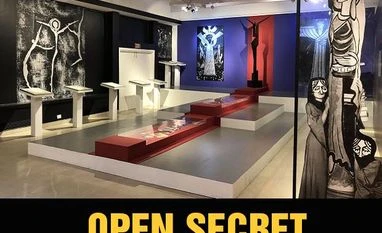
Opening Lines, an exhibition of this delightful trove of art, is on display at Delhi’s Art Heritage Gallery, which was founded by Alkazi and his wife, Roshen, in 1977, at the Triveni Kala Sangam. It has been curated by Bombay-based poet and cultural theorist, Ranjit Hoskote, who says he has known of the presence of the artworks sincehe was a teenager. With this one, Hoskote has virtually recreated the original exhibitions in London, Mumbai and Delhi.

Photo: Art Heritage Gallery
The exhibition is split between two gallery spaces: Art Heritage 1 and the Shridharani Gallery. The former displays Alkazi’s early works in different media, from sketch pen and marker, to ink, watercolour and poster paint, when he experimented with portraits and nudes, and referenced Neolithic drawings, African deities and Oceanic sculpture. The figure of Christ also appears abundantly in the works of this alumnus of two Jesuit institutions.

“The space of Art Heritage 1 has an inner circle, which displays installations of Alkazi’s work associated with his contemporaries, such as Ezekiel and M F Husain. And the walls surrounding it figures his early influences,” says Hoskote.

The Shridharani Gallery space contains landscapes and seascapes in charcoal from his later works. Alkazi’s granddaughter, Zuleikha Chaudhuri, also a theatre-director, has on display an annotated video work from archival material, Staging Medea/Performing an Archive as part of the exhibition in Art Heritage 2.

Alkazi turned 94 yesterday. These exhibition spaces are a fitting eulogy to a great artist and one of his beloved ideas: that art is one and it cannot be contained.
Opening Lines is on till November 11 at the Triveni Kala Sangam, New Delhi

One subscription. Two world-class reads.

Already subscribed? Log in

Subscribe to read the full story →
*Subscribe to Business Standard digital and get complimentary access to The New York Times

Smart Quarterly

₹900

3 Months

₹300/Month

SAVE 25%

Smart Essential

₹2,700

1 Year

₹225/Month

SAVE 46%
*Complimentary New York Times access for the 2nd year will be given after 12 months

Super Saver

₹3,900

2 Years

₹162/Month

Subscribe

Renews automatically, cancel anytime

Here’s what’s included in our digital subscription plans

Exclusive premium stories online

  • Over 30 premium stories daily, handpicked by our editors

Complimentary Access to The New York Times

  • News, Games, Cooking, Audio, Wirecutter & The Athletic

Business Standard Epaper

  • Digital replica of our daily newspaper — with options to read, save, and share

Curated Newsletters

  • Insights on markets, finance, politics, tech, and more delivered to your inbox

Market Analysis & Investment Insights

  • In-depth market analysis & insights with access to The Smart Investor

Archives

  • Repository of articles and publications dating back to 1997

Ad-free Reading

  • Uninterrupted reading experience with no advertisements

Seamless Access Across All Devices

  • Access Business Standard across devices — mobile, tablet, or PC, via web or app

Topics :artworksIndian artistsArt gallery

Next Story


