The space sector is hot again. Amazon boss Jeff Bezos will on July 20 launch himself into space on board a Blue Origin rocket, which he owns. Virgin Atlantic’s Richard Branson is also cooking up a space flight.
A similar urgency also seems to be nudging the Indian Space Research Organisation (Isro), which is determined to flag off some key missions. The Covid-19 pandemic, which clamped down hardware supply chains and manufacturing work at various Isro centres, postponed several launches. The agency has drawn up a calendar for at least six launches in 2021, including geo-spatial monitoring satellite GISAT-1 and pre-cursory flights to India’s first manned mission Gaganyaan, according to an official source.
“Covid-19 hit the supply pipeline for major missions but that is now recovering,” said the source. “One of the immediate focuses is the geo-monitoring satellite to be launched via GSLV. This was called off in March due to a technical difficulty.”
The agency is also trying to get back on track with the Gaganyaan mission. In February, Union Minister of State for Space Jitendra Singh had said that the first unmanned mission was planned for December 2021, and the second unmanned one for 2022-23, followed by the human spaceflight. The most-recent mission by Isro was the March 1 launch of PSLV-C51, which carried Brazilian satellite Amazonia-1, among a few smaller commercial satellites.
File photo of Isro Chairman K Sivan (second from left) with Jean-Yves Le Drian, minister for Europe and foreign affairs, France, at Isro headquarters | Photo: Isro
Isro’s move is not only motivated by lower Covid-19 cases but also by the significance of some of the projects. The Gaganyaan project – announced by Prime Minister Narendra Modi in his 2018 Independence Day Speech – was slated for August 2022 to mark the 75th anniversary of India’s Independence.
While that deadline is almost shelved, engines are revving to get back on track sooner than later. Isro did not respond to a request for comment.
Gaganyaan delayed till 2023
The Gaganyaan mission will slip to the year 2023. According to the plan, Isro will send three astronauts to space on board the Gaganyaan. An orbital capsule, Gaganyaan will orbit the Earth at a 400 km altitude for seven days and will be launched with the help of GSLV Mk III, a medium-lift launch vehicle that was also used for Chandrayaan-2. Four astronauts (one for standby) are currently undergoing a training in Russia.
If successful, the mission will put India alongside the US, China, and Russia in the list of countries that have achieved independent human spaceflight capabilities. To enable this, at least two unmanned missions must be successfully completed with identical conditions and infrastructure.
“While the design and development are done by Isro, the components are supplied by vendors from across the country,” said Abhishek Burman, a senior aerospace engineer associated with Indian institute of Sciences, Bengaluru. “The lockdowns combined with the risk of contamination have disrupted all schedules.”
Other launches planned this year include three earth observation satellites and a commercial satellite. The Aditya-L1, planned for studying the sun, won’t happen this year.
GISAT-1 focus, Chandrayaan postponed
In focus currently is the geo imaging satellite, or GISAT-1, a powerful imaging satellite that will significantly increase India’s geo-imaging capabilities. Weighing over 2,000 kg, the satellite will provide real-time images at frequent intervals – with applications in disaster management, weather analysis, and agriculture and forest surveys.
GISAT-1 will also improve India’s defence monitoring capability. Given the recent India-China skirmish along the Himalayan border region, New Delhi is pushing for a swifter deployment. According to the source, final tests are underway and the launch may take place in the second half of this year.
Isro tried to launch the satellite on two occasions in March, but called off the launch both times due to technical issues.
The agency, however, will not be able to accommodate the Chandrayaan 3 – the moon lander mission – this year. It was postponed to 2022-23, Isro Chairman K Sivan told reporters in February. This will be a re-attempt; the Chandrayaan-2 mission in September 2019 put an orbiter around the moon but the landing attempt failed and the rover crashed on the surface of the moon.
The Chandrayaan-3 is expected to target the same landing site – the uncharted Lunar South Pole – but unlike its predecessor it will not have an orbiter.
In a recent interview with news agency PTI, Sivan had said Covid-19 cases were found among staff at Isro’s Bangalore headquarters as well as the Sriharikota launch site. Currently, most of the centres are working at 50 percent capacity, with the HQ hosting a skeletal staff.
Focus on space exploration
Covid restrictions notwithstanding, Isro has been active this year in other ways, too. Over March, it met delegations from France, Saudi Arabia, Japan and Italy – both virtually and at its Bangalore headquarters – for efforts related to cross-border knowledge sharing. In February, Isro presented a virtual workshop for start-ups to part-take in space tech development.
There is a growing emphasis on space exploration. The funding for such projects has grown by about Rs 50 crore every year in the past three years, according to official data.
As things pick up on the ground, the government is also working on a long-term policy on human space flight. In February, India’s department of space put up the draft “Humans in Space Policy”. It proposed to create a road map for “sustained human presence in low earth orbit and undertaking exploration missions beyond low earth orbit.”

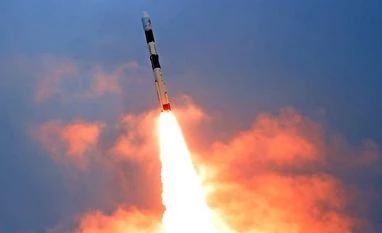 "As Covid restrictions ease, Isro puts in place aggressive launch timelines")












 Connect with us on WhatsApp