
Child health in India: 14 out of 20 states cut spending on key programmes
The child-care funding cuts come at a time when the central government reduced its allocations to the ministry of women and child development over two years to 2016-17
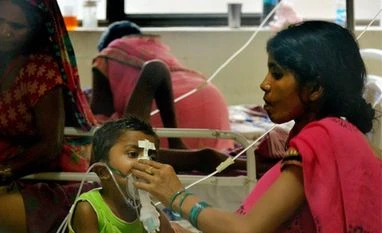 "Child health in India: 14 out of 20 states cut spending on key programmes")
premium
WebinarsNew
Deep DiveNew
Explore Business Standard
The child-care funding cuts come at a time when the central government reduced its allocations to the ministry of women and child development over two years to 2016-17
Despite greater fiscal autonomy and higher tax revenues shared by the Centre with states, 14 of 20 states surveyed cut spending on a key nutrition programme–Supplementary Nutrition Programme or SNP–that bridges the gap between a child’s actual and ideal dietary needs, according to an analysis of national health-spending data.
The SNP is the most popular service under the national child-support system–the Integrated Child Development Services (ICDS)–as it is used by 35.6% of urban and 53% rural residents, according to data from the National Family Health Survey 2015-16 (NFHS-4). As many as 55% and 61% of India’s lowest and second-lowest income classes, respectively, depend on the ICDS.
The fall in funding could jeopardise not just child health but, as a consequence, future productivity and economic growth; these cuts come three years after the Centre increased the states’ share of net tax revenues from 32% to 42% and at a time when two out of three nutritional parameters improved over 10 years to 2016. The greater share of net tax revenues to the states followed the recommendations of the 14th Finance Commission in 2015.
The other six states–Haryana, Uttar Pradesh, Madhya Pradesh, Himachal Pradesh, Sikkim and Karnataka–increased funding to the SNP over the same period (by 3% to 22%), data from the brief revealed.
The states that cut funding are: Jammu and Kashmir, West Bengal, Gujarat, Maharashtra, Punjab, Assam, Bihar, Jharkhand, Tripura, Orissa, Kerala, Telangana, Chhattisgarh and Nagaland.
Note: Change is for 2015-16 and 2016-17
Children are better off than before, but progress is slow
Spending on child health is central to making Indian children healthier–India currently trails not just emerging economies but many poorer countries on most parameters–the country’s future workforce being more productive and increasing economic growth, IndiaSpend reported in March 2018.
India has slowly improved its ranking on a global healthcare access and quality index from 153 in 1990 to 145 in 2016, yet it ranks lower than neighbouring Bangladesh and even sub-Saharan Sudan and Equatorial Guinea, we reported on May 23, 2018.
Over 10 years to 2015-16, the proportion of Indian children stunted–short for their age–went down from 38% to 28%, underweight (relative to their age) from 43% to 36%, but wasting–thin for their weight–rose from 20% to 21%, according to NFHS-4 data.
The child-care funding cuts come at a time when the central government reduced its allocations to the ministry of women and child development over two years to 2016-17, before increasing it over the following two financial years.
The allocations for anganwadis (day-care centres) fell over two years to 2016-17 before rising again over the next two, according to the budget brief.
Funding cuts impacting anganwadis
Bihar’s anganwadis were the worst affected, with no more than 80% working, while Sikkim, Maharashtra and Kerala were the least affected with 99% anganwadis operational.
As many as 76% of child development project officers and additional child development project officers posts were vacant on March 2017 in Maharashtra, while there were no vacancies for the same positions in Bihar and Mizoram, according to the budget brief.
West Bengal has the most anganwadi supervisor posts vacant (63%) while Madhya Pradesh has the least (17%). Nationally, vacancies were unchanged between March 2015 and March 2017, data show.
(Pallapothu, an MSc student at the Symbiosis School of Economics, Pune, is an intern with IndiaSpend.)
Already subscribed? Log in
Subscribe to read the full story →

3 Months
₹300/Month
1 Year
₹225/Month
2 Years
₹162/Month
Renews automatically, cancel anytime

Premium stories handpicked daily by our editors


News, Games, Cooking, Audio, Wirecutter & The Athletic
Digital replica of our daily newspaper — with options to read, save, and share


Insights on markets, finance, politics, tech, and more delivered to your inbox
In-depth market analysis & insights with access to The Smart Investor


Repository of articles and publications dating back to 1997
Uninterrupted reading experience with no advertisements


Access Business Standard across devices — mobile, tablet, or PC, via web or app
First Published: May 30 2018 | 7:59 AM IST

