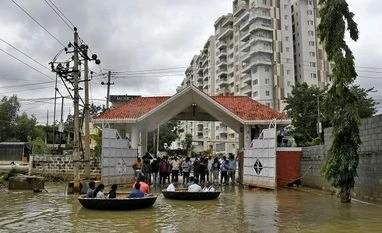
Bengaluru, India’s Silicon Valley, was once a shining example of rapid urbanisation, job generation, and the growth of new-age businesses. But everything came crashing down with the city having had to battle urban flooding the past few weeks. Overnight rain —the heaviest for September in 75 years — submerged large parts of the city, causing an estimated loss of Rs 225 crore.
But Bengaluru is not a standalone case. States and cities face a breakdown in infrastructure every year owing to extreme weather events. Climate change is causing unseasonal phenomena and exacerbating the impact of natural disasters on infrastructure in most cities, including metro towns.
Cloud of uncertainty
The South East Arabian Sea, which is warming at a higher rate thanks to rapid climate change, has become a hotspot for convective clouds and severe rain, said Abhilash S, associate professor, Department of Atmospheric Sciences at the Cochin University of Science and Technology.
“Cities are not built to contain these short intense spells. The drainage system can hold 20 cm of rain if it is distributed throughout the day but it cannot hold 15 cm rain in three-four hours,” he said.
Scientists say these short bursts of heavy rain will only increase in the future, especially in coastal India, and it is high time infrastructure and policy planning took climate change into account.
This year, Hyderabad and Ahmedabad, along with Mumbai, like every year, faced heavy rain-induced urban flooding, leading to a collapse of infrastructure and services. During the past 65 years, floods took 109,412 lives and damaged over 258 million hectares of crops, amounting to losses of about Rs 4.69 trillion, according to the Central Water Commission (CWC).
Experts are of the view that urban India is now facing the twin challenges of infrastructure redevelopment and climate adaptation, both of which are out of the purview of the sparsely financed municipal corporations.
Different cities, similar crises
“India is experiencing one of the biggest urban growth spurts in history. However, this is happening when 75 per cent of India’s 2050 infrastructure is yet to be built. It is also happening in the most unplanned way, infringing upon environmentally sensitive areas at a time when cities are most vulnerable to climate-change impacts,” said Jaya Dhindaw, program director, Integrated Urban Development, Planning and Resilience, World Resources Institute (WRI).
The 74th constitutional amendment in 1992 provided for the establishment and empowerment of urban local bodies as local self-governing institutions. Dhindaw said enforcing the amendment in its entirety still eluded several cities.
Across states, the situation of public works in the cities, especially that relating to drainage and rain water disposal, is dismal. Last October, a Comptroller and Auditor General (CAG) report found irregularities in storm water drain connectivity in the city and delays by the Bruhat Bengaluru Mahanagara Palike (BBMP) in removing lake encroachments. The BBMP has removed barely 25 per cent encroachments near water bodies in various zones, it said.
Mumbai got its first “Storm Water Disposal System” project in 1985 but the work commenced after the 2005 floods. The project was to cost Rs 616.30 crore in 1991 and conclude by 2003. But as of April 2021, a sum of Rs 2,439.35 crore had been spent on it and an additional investment of Rs 2,700 crore was still required, according to the Environment Status Report by the Brihanmumbai Municipal Corporation on this project.
Delhi’s first “Drainage Master Plan” was prepared in 1976 and the city is still running on that plan. The Public Works Department (PWD) was supposed to engage with consultants for redevelopment, but as of July 2002, no progress has been made.
The state finances analysis of the Reserve Bank of India (RBI) in 2020-21 found municipal corporations had come under severe financial strain, forcing them to cut expenditure and mobilise funding from various sources. About 35 per cent of the 221 corporations it surveyed were severely fiscally stressed “on account of lower share of its own revenue or higher dependence on upper tiers of the government or higher share of committed expenditure”, the RBI said.
The fiscal maths worsened during the two Covid years. The RBI’s report called for raising the financial autonomy of the corporations and inducing financial reforms “for better public services such as healthcare and other civic amenities”.
Dhindaw said the need of the hour was investment in sustainable and resilient infrastructure along with addressing governance and financing gaps and consumption patterns.
With their master plans for redevelopment delayed severely, Indian cities have a lot to catch up with, even as climate havocs worsen with every passing year.
With inputs from Karthik Jerome