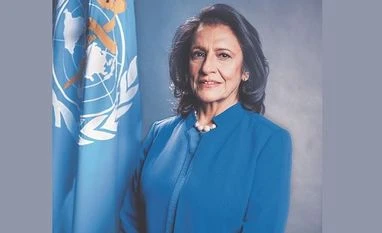
Even as several countries were planning to roll out coronavirus vaccines as early as in December or January, doses of these vaccine were unlikely to available before early- or mid-2021, World Health Organization (WHO) Southeast Asia Regional Director Dr Poonam Khetrapal Singh told Business Standard.
“It is hoped that if a successful vaccine is found within the next few months, enough doses will be available for countries by the end of 2021 so that those in priority populations who choose to be vaccinated have access to them,” Singh said.
Even the front-runners among vaccine companies would take at least a few months to complete Phase-III trials and evaluate the efficacy and safety of individual vaccines, she said. Add to this the time taken for licensure, authorisation for use and mass production after the trials have been completed.
The Covax facility, a specially created financial instrument to help countries get equitable access to Covid-19 vaccines, requires $ 2 billion this year and another $5 billion in 2021 to meet the targeted vaccine coverage, according to WHO estimates.
Countries would receive an initial tranche of doses through Covax until they covered 3 per cent of the population. This would allow the vaccination of highest-priority individuals, likely the frontline workers in health and social care settings. This would be followed by additional tranches gradually as more supply would become available, until 20 per cent of the population is covered, to vaccinate the most at-risk groups, Singh added.
So far, 187 countries and economies have signed up for the Covax facility, including self-financing ones and the 92 lower-income countries eligible for financial support through Gavi, the international organisation created to improve access to new and underused vaccines for children in the world's poorest countries.
The Southeast Asia head of WHO said India would have an important role to play, with manufacturers gearing up their production capacities to produce Covid-19 vaccines. “India is the world’s pharmacy... More than half the vaccines produced worldwide are produced in India.”
On certain rich countries placing bulk orders for the vaccine, she said while there was a wish among leaders to protect their own people first, WHO continued to advocate for and emphasise that the response to the pandemic must be collective. “No one is safe until everyone is safe. Vaccines are a global public good.”
Currently, around 200 vaccine candidates are at some stage of development. Of these, at least 45 are in the human-trial stage. About 10 are in Phase-III trials. Several others currently in Phase-I or -II will enter Phase-III in the next two months. “While the vaccine pipeline looks promising, we cannot say with certainty when a vaccine will be available for administration to populations.”
Among the front-runners are University of Oxford-AstraZeneca vaccine; Sinovac, Sinopharm, Cansino vaccines being developed by the Beijing Institute of Biotechnology, the Beijing Institute of Medical Products and the Wuhan Institute of Biological Products; Russia’s Sputnik V being developed by Gamaleya Research Institute; Moderna-National Institute of Allergy and Infectious Diseases vaccine; the vaccine being produced by Jansen Pharmaceutical Companies; and the BioNTech-Pfizer vaccine.
“Till such time as there is a vaccine or medicine, it’s difficult to say with certainty when the region (Southeast Asia) and the rest of the world will return to pre-pandemic times... As we transition to the new normal and return to some sort of normalcy, we must also remember that this new normal does not mean business as usual. We must remain vigilant,” Singh said.
WHO is working with companies and sponsors, as well as with Gavi, Coalition for Epidemic Preparedness Innovations, and others, through the access to Covid tools accelerator to expedite vaccine testing, as well as the scale-up of manufacturing, so that countries have access to sufficient doses if and when a vaccine is available, according to Singh.

 "Covid-19 vaccine unlikely before early or mid-2021: WHO Southeast Asia head")










 Connect with us on WhatsApp