Covid concerns return with cases on the rise; DDMA may make masks mandatory

As on April 16, Delhi-NCR accounted for 52.5 per cent of the country's total cases - up from 11.8 per cent on April 1
Coronavirus, Gurugram
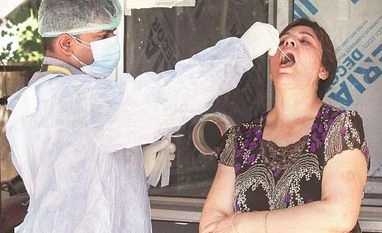
A healthworker collects swab samples of a Gurugram resident for Covid-19 testing, on Saturday
Sohini DasIshaan Gera Mumbai/New Delhi
5 min read Last Updated : Apr 18 2022 | 6:05 AM IST
With India reporting a steady rise in Covid-19 cases, especially in the National Capital Region (NCR), the government machinery has sprung back to action.

As on April 16, Delhi-NCR accounted for 52.5 per cent of the country’s total cases — up from 11.8 per cent on April 1.
Officials said while there is no need to panic, surveillance and active monitoring of the situation are imperative.

The Delhi Disaster Management Authority (DDMA) is likely to make masks mandatory again following its meeting this week. 

Lieutenant Governor Anil Baijal, Chief Minister Arvind Kejriwal, Delhi Health Minister Satyendar Jain, NITI Aayog member VK Paul and All India Institute of Medical Sciences Director Randeep Guleria are expected to attend the meeting. Delhi’s trader organisations have urged DDMA to consider making masks mandatory again so that the situation does not spiral out of control.
Positivity rates are quite high in the NCR region: Gurugram (10.1 per cent), Gautam Buddha Nagar (7.65 per cent), Faridabad (5.5 per cent).

Given this scenario, Mumbai, too, is on alert.

“All our testing centres are open, and free testing is happening there,” said Suresh Kakani, additional municipal commissioner, Brihanmumbai Municipal Corporation (BMC). “We recently held a meeting with general practitioners and asked them to refer every patient with influenza-like symptoms for RT-PCR testing. They can go to the civic body-run centres so that the testing is not a financial burden for them.”
Of the 43 patients who tested positive in Mumbai on Saturday, 42 were asymptomatic, while one was hospitalised. Mumbai tested 9,484 samples in the last 24-hours till Saturday evening.

At the time of going to print, 15 of the 26,143 Covid beds avail-able were occupied in Mumbai. The civic body has not asked hospitals to shut down the Covid-19 wards completely.

Kakani said that hospitals — both public and private — have been asked to maintain at least one Covid-19 ward — of 25 to 40 beds, depending on the size of the hospital. “We have told them they should be ready to re-operationalise the Covid-19 wards at full scale at a 48-hour notice,” Kakani said.

In a recent sero-survey, BMC found that 98-99 per cent of the healthcare and frontline workers have high antibody titers. 

“The drivers and conductors of BEST buses and the healthcare workers have very high levels of antibodies in their samples. 

Had this number been any less, we were thinking of asking these workers to wear masks mandatorily. We are running campaigns (on radio, for one) to encourage people to wear masks, though masks are not mandatory yet,” Kakani said, adding that Mumbai’s positivity rate is around 0.5 per cent.

On April 8, Union Health Secretary Rajesh Bhushan wrote to Delhi, Maharashtra, Kerala, Haryana and Mizoram — areas contributing to most cases in the national tally — asking them to maintain strict vigilance and adopt measures for prompt and effective management of the pandemic.

Kejriwal said while there was no need to panic, the government was keeping a close watch on the situation. Health Minister Jain has asked hospitals to remain alert.

Meanwhile, Mumbai is so far not screening passengers arriving from Delhi. It is conducting genomic surveillance of the samples actively, though.

Kakani said the person from Gujarat infected with the XE variant, who had travelled to Maharashtra, had not spread the infection here. “His close contacts were tested; none of them had the XE variant. So far, there is no confirmed case of XE in Mumbai,” Kakani said.

The rise in cases may be a result of more free mixing among the population, said health experts. They also said that the Omicron and subsequent variants of the Sars-CoV-2 virus are causing upper respiratory tract infections.

“We do not have mucosal immunity yet as we do not have an intranasal vaccine. Therefore, there is always a chance of getting an infection from the nasal or throat route,” said E Sreekumar, chief scientific officer, Rajiv Gandhi Centre for Biotechnology.  

He added that so far, unlike the Wuhan and Delta strains that were causing pulmonary infections, the current strains cause upper respiratory tract infections. “This is why many cases may go undetected. We need to continue our surveillance actively, and also monitor what percentage of the confirmed Covid cases progress to moderate to severe disease,” Sreekumar added.

Should masks be back? “It is not necessary to make mask-wearing mandatory. It would not help with herd immunity,” Sreekumar said but clarified that “people need to apply discretion about when they need to wear masks (in crowded places or when meeting unknown people).”

Children under 12 years might be getting infected, as data from Delhi indicates, since this segment has not been vaccinated. 
Out of 51 hospitalised patients in Delhi as on April 16, around 27 per cent were children, and most of them had comorbidities.

Kakani said we are encouraging booster shots for whoever is eligible. Sreekumar, however, felt it’s unlikely there’d be demand for paid booster shots.

T Jacob John, senior virologist and former head of the departments of clinical virology and microbiology at Christian Medical College (CMC), Vellore, added: “No vaccination regimen is complete without booster doses, and thus the Covid vaccination, too, needs the third shot.”

One subscription. Two world-class reads.

Already subscribed? Log in

Subscribe to read the full story →
*Subscribe to Business Standard digital and get complimentary access to The New York Times

Smart Quarterly

₹900

3 Months

₹300/Month

SAVE 25%

Smart Essential

₹2,700

1 Year

₹225/Month

SAVE 46%
*Complimentary New York Times access for the 2nd year will be given after 12 months

Super Saver

₹3,900

2 Years

₹162/Month

Subscribe

Renews automatically, cancel anytime

Here’s what’s included in our digital subscription plans

Exclusive premium stories online

  • Over 30 premium stories daily, handpicked by our editors

Complimentary Access to The New York Times

  • News, Games, Cooking, Audio, Wirecutter & The Athletic

Business Standard Epaper

  • Digital replica of our daily newspaper — with options to read, save, and share

Curated Newsletters

  • Insights on markets, finance, politics, tech, and more delivered to your inbox

Market Analysis & Investment Insights

  • In-depth market analysis & insights with access to The Smart Investor

Archives

  • Repository of articles and publications dating back to 1997

Ad-free Reading

  • Uninterrupted reading experience with no advertisements

Seamless Access Across All Devices

  • Access Business Standard across devices — mobile, tablet, or PC, via web or app

Topics :CoronavirusCoronavirus Testspublic health

Next Story



