
Diwali 2018: Delhiites pick crackers over clean air, violate SC time frame
The Supreme Court had allowed bursting firecrackers only between 8 PM and 10 PM on Diwali
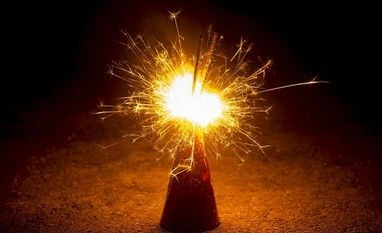 "Diwali 2018: Delhiites pick crackers over clean air, violate SC time frame")
WebinarsNew
Deep DiveNew
Explore Business Standard
The Supreme Court had allowed bursting firecrackers only between 8 PM and 10 PM on Diwali
Dashing hopes of a cracker-free festivities, Delhiites chose to celebrate a noisy and hazy Diwali Wednesday with people in many areas bursting fire crackers beyond the 8 pm to 10 pm time frame, stipulated by the Supreme Court.
Admitting "sporadic" breaches of the apex court order on bursting crackers beyond the time frame fixed by it, senior Delhi police officials said, "We are monitoring the situation."
"There have been sporadic cases of violations. In some areas, people have been found burning firecrackers beyond 8pm-10pm time frame. The exact number of violation is yet to be ascertained. But, we will take strict action against them," said an official.
The Supreme Court had allowed bursting firecrackers only between 8 PM and 10 PM on Diwali, while permitting manufacturing and sale of only "green crackers" with low emission of light, sound and smoke.
The court had asked police to ensure that there is no sale of banned firecrackers and in case of any violation, the station house officers of the police stations concerned would be held "personally liable".
This would amount to committing the contempt of court, the apex court had ruled.
Some of the areas where the people were seen bursting crackers beyond the apex court-stipulated time frame included Mayur Vihar Extension, Lajpat Nagar, New Delhi's Lutyens Zone, IP extension, Dwarka, Noida-Sector 78. The intensity of the crackers burst before 8 PM, however, remained low.
The online indicators of the city's pollution monitoring stations indicated poor and 'very poor' air quality as the volume of ultra fine particulate materials PM2.5 and PM10, which enter the respiratory system and manage to reach the bloodstream, sharply rose from around 8 pm.
The pollutants had breached the corresponding 24-hour safe limits of 60 and 100 respectively by up to three times.
While it is difficult to quantify the immediate effect of the ban on firecrackers, residents across the national capital felt the beginning was promising with the neighbourhoods reporting much lesser noise and smoke till about 8 pm.
But as the festivities picked up, the faint echo of crackers started growing louder.
According to the Central Pollution Control Board data, the 24-hour rolling average of PM2.5 and PM10 were 146 and 275 micrograms per cubic metre respectively.
The SAFAR (System of Air Quality and Weather Forecasting And Research) has forecast "bad" air quality on Thursday even if partially toxic crackers, as compared to 2017, is burned. It also said the pollution level will peak between 11 AM and 3 AM on Wednesday and Thursday.
The situation was similar, if not worse, in the neighbouring regions of Delhi such as Gurgaon, Noida and Ghaziabad, where crackers were burst as usual, raising question marks on the efficacy of the administration in enforcing the apex court's ban.
A 'very poor' air quality index (AQI) essentially means that people may suffer from respiratory illnesses on a prolonged exposure to such air. If the air quality dips further, the AQI will turn 'severe', which may trouble even those with sound health conditions and seriously affect those with ailments.
The Centre, in collaboration with the Delhi government, has launched an aggressive 10-day-long 'Clean Air Campaign' from November 1 to 10 to monitor and report polluting activities as well as to ensure quick action.
About 52 teams deployed under the campaign are visiting different parts of Delhi and adjacent towns of Faridabad, Gurgaon, Ghaziabad and Noida.
The teams comprise the local sub divisional magistrate (SDM) as the team leader, senior officials from the Ministry of Environment, Forest and Climate Change (MoEFCC) and representatives from the CPCB, Municipal Corporation of Delhi (MCD) and the DPCC.
First Published: Nov 07 2018 | 10:50 PM IST


 Connect with us on WhatsApp