India among top 10 FDI destinations in 2014
The Unctad report said India's FDI inflows would continue to rise in 2015 as an expected economic recovery gained ground
BS Reporter New Delhi India moved up six places to become, for the first time, one of the top 10 destinations for foreign direct investment (FDI) in 2014, according to the United Nations Conference on Trade and Development (Unctad)'s World Investment Report 2015. It was 15th on the list in 2013.
FDI inflows into India were $34 billion in 2014, up 22 per cent rise from $28 billion in 2013. In fact, Inflows into the country were 83.5 per cent of South Asia's $41.2 billion, including Iran and the seven other member nations of the South Asian Association for Regional Cooperation.
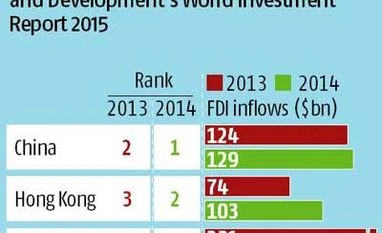
Among the top 10 recipients, China, Hong Kong and the US accounted for the biggest share (in that order). China took the top spot with FDI of $129 billion in 2014 ($124 billion in 2013). The US, which attracted $231 billion worth of FDI in 2013, only garnered $92 billion in 2014. Hong Kong got $103 billion of FDI in 2014.
Others in the top 10 in 2014 were the UK (fourth), Singapore (fifth), Brazil (sixth), Canada (seventh), Australia (eighth) and the Netherlands (10th).
The Unctad report said India's FDI inflows would continue to rise in 2015 as an expected economic recovery gained ground. "In terms of structural composition, manufacturing is gaining strength, as policy efforts to revitalise the sector are sustained, including, for instance, the launch of the 'Make In India' initiative in mid-2014," the report said.
Under the 'Make In India' initiative, the Narendra Modi government has identified 25 industrial sectors in which India has the potential to be a world leader, including automotives, chemicals, pharmaceutical and textile industries, it said.
"In the manufacturing sector in South Asia, FDI success stories have emerged at country, industry and local levels, with the automotive industry in India showing how large-scale FDI inflows can reshape the trajectory of industrial progress in low income countries," the report said.
The report said automotive industry, which India opened up to FDI in 1991, was a key part of the Indian economy and had been identified as a key sector in which India could become a world leader.
The country accounted for most of the new investment projects announced by global automobile makers and first-tier parts suppliers in South Asia during 2013 and 2014, including 12 projects above $100 million, the report said. "Investment from the growing automotive industry in India shows potentials of a positive 'spillover effect' to productive capacity building in South Asia as a whole," the Unctad report said. As an example, the report noted Mahindra's $200-million (about Rs 632-crore) proposed investment in a plant in Bangladesh for trucks and utility vehicles.
Among the positive trends in South Asia, the report said Pakistan and Sri Lanka were receiving greater FDI flows from China, Bangladesh saw an increase in new projects and Nepal was attracting more attention from multinational companies.
The report noted there was greater need for coherence between international taxation and investment policies. It said the policy imperative should be to take action against tax avoidance to support domestic resource mobilisation and to continue to facilitate productive investment.

 "India among top 10 FDI destinations in 2014")


 Connect with us on WhatsApp