3 min read Last Updated : Jan 20 2022 | 11:03 PM IST
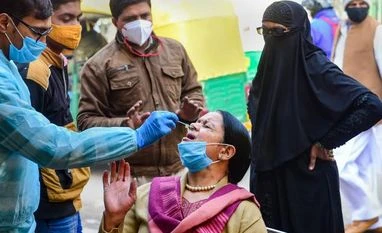
India logged over 317,000 cases on Thursday morning and the country’s daily positivity rate exceeded 16 per cent. Meanwhile, January has witnessed a dramatic increase in home testing, even as overall testing numbers have, barring a few districts, remained the same as in the second wave, health ministry data showed. While in 2021, 3,000 home tests were used, January 2022 has already seen over 200,000 such tests.
The health ministry expressed worry over rising cases and high positivity rate in six states: Maharashtra, Karnataka, Tamil Nadu, Kerala, Delhi and Uttar Pradesh. “We are in continuous contact and dialogue with these states. I have briefed the health administration of these states,” Health Secretary Rajesh Bhushan said.
India has so far vaccinated 94 per cent of its adult population with one dose of Covid vaccine and 72 per cent with both doses. On April 30, 2021, during the second wave of Covid-19, the fully vaccinated population stood at 2 per cent. At the time, 386,452 new cases, 3,059 deaths and 3,170,228 active cases were recorded, health ministry data shows. On January 20, 2022, while the total daily cases were comparable to the second wave, the number of deaths were lower at 380 and active cases stood at 1,924,051.
“Benefits of vaccines in reducing deaths can be seen week by week through data. The current surge is not leading to severe disease and death due to high uptake of vaccines. Those with comorbidities should monitor their health,” said Balram Bhargava, director general, Indian Council of Medical Research.
“There are still over 65 million people who are overdue to take their second dose. This will weaken our shield. They must come forward and get fully vaccinated. Reminders are being sent,” V K Paul, member-health, Niti Aayog, said.
On vaccines for children below 15, Paul said, “We will take a holistic view of the situation. Work is happening on this front as well.”
Health ministry data suggested that the incidence of Covid cases during the first two waves were similar in paediatric and adolescent population: those up to 19 years made for 10 per cent of the total cases in 2020 and 11 per cent in 2021. And the deaths were 0.96 per cent and 0.7 per cent in this age group for 2020 and 2021 respectively.
During the current way, the rate of hospitalisation has been low, said the government. In Delhi, for instance, with over 75,000 active cases and 13,000 daily cases, the number of those hospitalised is around 2,624, the health ministry said.
Around 99 per cent patients have common symptoms of fever, with or without rigours, cough, irritation in throat, and these signs usually wane after the fifth day of infection, according to the Delhi case study. In 11- to 18-year-old patients, fever is a common symptom along with upper respiratory tract infection.
Nearly 52 per cent of adolescents in the 15-18 age group have taken their first dose of the vaccine.