That was two-and-a-half years ago, and one particular anxiety has been put to rest now. Swayamprabha delivered twin boys last month, on July 20, free of the hereditary cancer gene, in the first instance of this kind of medical intervention in India. There are only about 140 other such cases across the world.
Ever since she tested positive for the “cancer gene”, Swayamprabha has been taking multiple blood tests every six months to check for cancer. For two years after getting married in 2009, she could not decide if she wanted to conceive at all. “Our doctors in Bengaluru told us that science is improving and your child may not even get cancer till the age of 25, based on my medical history,” Swayamprabha recalls. However, after her miscarriages, the couple began losing hope as doctors suggested they wouldn’t be able to conceive naturally.
In vitro fertilisation, commonly known as IVF, is a 40-year-old technology that assists reproduction in cases where chances of doing so naturally are low. While the technology was developed to help infertile couples conceive, today it can be used to address genetic or hereditary disorders as well. Intra-Cytoplasmic Implantation (ICSI) along with Pre-Implantation Genetic Testing (PGT) gave Swayamprabha what she had been wishing for.
According to Parikh, the environment’s interaction with DNA in the human body has increased vulnerability to diseases such as cancer. While DNA is in a constant process of repair, the smallest mutation, a result of incorrect “repair”, can lead to mental and physical disorders. PGT becomes helpful in screening the embryo for genetic problems before the embryo is implanted in the uterus to decrease the burden of disease on the couple’s children.
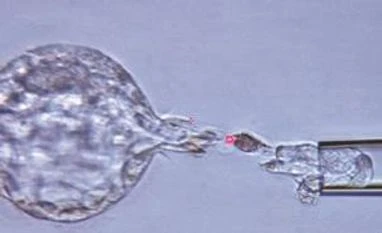
The procedure yielded six blastocyst stage embryos. The Pre-PGT check-up conducted by Parikh allowed her to locate the exact spot in the chromosome where the mutation had taken place and a delicate biopsy of a few cells surrounding the embryo was performed by micromanipulation. These were then sent for genetic analysis. Two embryos were found healthy and free of BRAC1 mutation. These embryos were implanted in Swayamprabha’s uterus. She was first treated with hormones to obtain an adequate number of ova or eggs that were extracted under mild anesthesia. Using the ICSI technology, a single sperm was injected into the cytoplasm of each mature egg manually in the embryology laboratory under a special microscope, fitted with a micromanipulator and a laser. This was followed by incubation to allow fertilisation and formation of the embryo.
“One must use whatever technology one has today to offer the best health care possible,” says Parikh, of this seeming medical miracle. Of course, not everyone can afford the cost of miracles — the couple spent upwards of a few lakh of rupees to achieve this remarkable result.
One subscription. Two world-class reads.
Already subscribed? Log in
Subscribe to read the full story →
Smart Quarterly
₹900
3 Months
₹300/Month
Smart Essential
₹2,700
1 Year
₹225/Month
Super Saver
₹3,900
2 Years
₹162/Month
Renews automatically, cancel anytime
Here’s what’s included in our digital subscription plans
Exclusive premium stories online
Over 30 premium stories daily, handpicked by our editors


Complimentary Access to The New York Times
News, Games, Cooking, Audio, Wirecutter & The Athletic
Business Standard Epaper
Digital replica of our daily newspaper — with options to read, save, and share


Curated Newsletters
Insights on markets, finance, politics, tech, and more delivered to your inbox
Market Analysis & Investment Insights
In-depth market analysis & insights with access to The Smart Investor


Archives
Repository of articles and publications dating back to 1997
Ad-free Reading
Uninterrupted reading experience with no advertisements


Seamless Access Across All Devices
Access Business Standard across devices — mobile, tablet, or PC, via web or app
)