India to resume Covid vaccine exports in 2022: Head of govt expert panel

A second wave of Covil infections and local supply delays prompted the government to prioritize its own citizens and halted overseas shipments of vaccines in April.
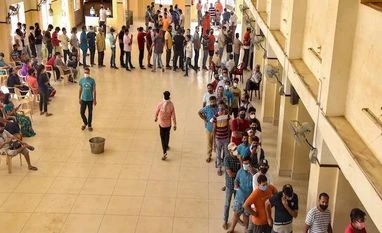
Visitors wait to get their dose of Covid-19 vaccine at an inoculation centre in Bikaner, Sunday, Aug. 8, 2021. (PTI Photo)
Chris Kay and Archana Chaudhary | Bloomberg
3 min read Last Updated : Aug 24 2021 | 1:24 PM IST
India will likely restart exporting Covid-19 vaccines next year once it has immunized its own adult population, the head of an influential government expert panel said.

“Almost 60 countries are hardly having any access to vaccine and India should be able to provide a substantial portion in 2022,” N.K. Arora, chairman of the National Technical Advisory Group on Immunization in India, said in an interview with Bloomberg Television on Tuesday. “As soon as we are through with our adult population we should have sufficient vaccine to share with the rest of the world.”

The South Asian nation, which has the second largest Covid outbreak with 32.5 million infections, should have six locally-developed shots by the end of 2021, Arora said. As the head of vaccine advisory group, he helps the Indian federal government evaluate new vaccines as well as review data from those already rolled out.

Home to the world’s biggest vaccine-producing industry, India earlier this year was shipping out shots to poorer nations amid Prime Minister Narendra Modi’s much-touted vaccine diplomacy. There was also an expectation that the country would be a major supplier to the World Health Organization-backed Covax effort for global equitable access to these vaccines. 

But the onset of a devastating second-wave of infections and local supply delays prompted the government to prioritize its own citizens and halted overseas shipments in April.

Covax has since struggled to make up for the shortfall, looking instead to countries such as China to fill the gap as India slowly bolsters its own capacity. A boosted portfolio of vaccines by the year end should cover Indian government’s plans to fully immunize 920 million adults, Arora said.

“That means our requirement will be 1.8 million doses by that time,” he said. “The way our pipeline is we should be able to reach and meet our target by the end of the year.”

Upcoming production

Already vaccines from AstraZeneca Plc--churned out by the Serum Institute of India Ltd. --and Bharat Biotech International Ltd. are being widely deployed in the country, while doses from Cadila Healthcare Ltd. and Russia’s Sputnik V are expected to begin local production in coming months. 

Serum, the country’s largest supplier, should be raising its monthly contribution to about 150 million doses from almost 120 million shots currently, Arora said. By September, Bharat Biotech will provide about 120 million doses after “some initial glitches.” Other Indian vaccine makers, Biological E. Ltd. and Genova Biopharmaceuticals Ltd., should also start contributing to the supplies, he said.

India has so far administered more than 589 million doses, but even that huge coverage has only fully vaccinated about 10% of the population, according to Bloomberg’s vaccine tracker. 

Arora said that India isn’t looking to imported vaccines to help boost its own supplies. The country has been negotiating with foreign vaccine makers, such as Pfizer Inc., over legal indemnity clauses that the companies are demanding but there’s been no breakthrough yet.

“We are totally, kind of, banking on indigenously manufactured vaccines,” he said. “Our estimates on supply lines do not take into account any of the vaccines from abroad.”

(With assistance from Bibhudatta Pradhan, Adrian Wong and Anand Menon.)

(Only the headline and picture of this report may have been reworked by the Business Standard staff; the rest of the content is auto-generated from a syndicated feed.)


One subscription. Two world-class reads.

Already subscribed? Log in

Subscribe to read the full story →
*Subscribe to Business Standard digital and get complimentary access to The New York Times

Smart Quarterly

₹900

3 Months

₹300/Month

SAVE 25%

Smart Essential

₹2,700

1 Year

₹225/Month

SAVE 46%
*Complimentary New York Times access for the 2nd year will be given after 12 months

Super Saver

₹3,900

2 Years

₹162/Month

Subscribe

Renews automatically, cancel anytime

Here’s what’s included in our digital subscription plans

Exclusive premium stories online

  • Over 30 premium stories daily, handpicked by our editors

Complimentary Access to The New York Times

  • News, Games, Cooking, Audio, Wirecutter & The Athletic

Business Standard Epaper

  • Digital replica of our daily newspaper — with options to read, save, and share

Curated Newsletters

  • Insights on markets, finance, politics, tech, and more delivered to your inbox

Market Analysis & Investment Insights

  • In-depth market analysis & insights with access to The Smart Investor

Archives

  • Repository of articles and publications dating back to 1997

Ad-free Reading

  • Uninterrupted reading experience with no advertisements

Seamless Access Across All Devices

  • Access Business Standard across devices — mobile, tablet, or PC, via web or app

Topics :CoronavirusCoronavirus VaccineAstraZeneca

Next Story


