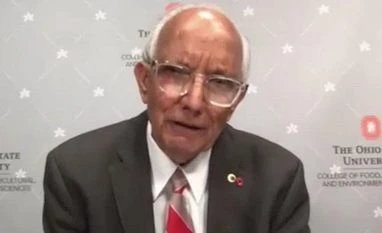
Indian-American soil scientist Rattan Lal wins 2020 World Food Prize

US Secretary of State, Michael Pompeo, praised Lal, saying he is helping nearly 500 million small farmers through improved management, less soil degradation, and recycling of nutrients

Rattan Lal
Rattan Lal began his research career at the International Institute of Tropical Agriculture in Nigeria, developing soil health restoration projects across Asia, Africa, and Latin America. | Pic: Twitter
ANI
4 min read Last Updated : Jun 12 2020 | 8:30 AM IST

Renowned Indian-American soil scientist Dr Rattan Lal has been awarded the 2020 World Food Prize for developing and mainstreaming a soil-centric approach to increase food production that conserves natural resources and mitigates climate change.

US Secretary of State, Michael Pompeo, has praised Lal, saying he is helping nearly 500 million small farmers through improved management, less soil degradation, and recycling of nutrients.

Lal was announced as the 2020 World Food Prize Laureate on Thursday. He received the $250,000 award for promoting soils for sustainable development.

The 2020 Laureate Announcement Ceremony featured pre-recorded remarks from Pompeo and US Secretary of Agriculture Sonny Perdue with World Food Prize Foundation President Barbara Stinson announcing the name of the Laureate, the World Food Priz foundation said in a statement.

"The world's population continues to grow, and we need to use the resources we have more productively and efficiently to make sure everyone has enough food on their table," said Secretary Pompeo.

"Dr. Lal's research in soil science shows that the solution to this problem is right under our feet. He's helping the earth's estimated 500 million small farmers be faithful stewards of their land through improved management, less soil degradation, and the recycling of nutrients. The billions of people who depend on these farms stand to benefit greatly from his work," he said.

From his humble beginnings as a refugee growing up on a small subsistence farm in India, Lal's determination to learn and succeed in school propelled him to become one of the world's foremost soil scientists, read the statement.

Dr Lal expressed excitement on receiving the 2020 World Food Prize but said that the urgent task of feeding humanity is not fulfilled until each and every person has access to an adequate amount of nutritious food grown on healthy soil and in a clean environment.

"The unbound joy and excitement of receiving the 2020 World Food Prize reminds me about the gratitude, privilege, and honor of working for farmers from around the world," said Dr. Lal, who now serves as Distinguished University Professor of Soil Science and founding Director of the Carbon Management and Sequestration Center at The Ohio State University (OSU).

"Yet, the urgent task of feeding humanity is not fulfilled until each and every person has access to an adequate amount of nutritious food grown on healthy soil and in a clean environment," he added

Lal began his research career at the International Institute of Tropical Agriculture in Nigeria, developing soil health restoration projects across Asia, Africa, and Latin America.

He explored and transformed techniques such as no-tillage, cover cropping, mulching, and agroforestry that protected the soil from the elements, conserved water, and returned nutrients, carbon, and organic matter to the soil. This in turn improved the long-term sustainability of agroecosystems and minimized the risks to farmers of droughts, floods, and other effects of a changing climate.


In 1987, he returned to his alma mater, OSU, where his research showed how atmospheric carbon can be sequestered in soils. This breakthrough research transformed the way the world saw soils.

As a result, soils are now not only the foundation for increasing the quality and quantity of food and preserving natural ecosystems but an important part of mitigating climate change, as well.

Three separate United Nations Climate Change Conferences adopted his strategy of restoring soil health as a means to sequestering carbon.

In 2007, he was among those recognised with a Nobel Peace Prize Certificate for his contributions to the Intergovernmental Panel on Climate Change (IPCC) reports, when the IPCC was named co-recipient of the Nobel Prize.

One subscription. Two world-class reads.

Already subscribed? Log in

Subscribe to read the full story →
*Subscribe to Business Standard digital and get complimentary access to The New York Times

Smart Quarterly

₹900

3 Months

₹300/Month

SAVE 25%

Smart Essential

₹2,700

1 Year

₹225/Month

SAVE 46%
*Complimentary New York Times access for the 2nd year will be given after 12 months

Super Saver

₹3,900

2 Years

₹162/Month

Subscribe

Renews automatically, cancel anytime

Here’s what’s included in our digital subscription plans

Exclusive premium stories online

  • Over 30 premium stories daily, handpicked by our editors

Complimentary Access to The New York Times

  • News, Games, Cooking, Audio, Wirecutter & The Athletic

Business Standard Epaper

  • Digital replica of our daily newspaper — with options to read, save, and share

Curated Newsletters

  • Insights on markets, finance, politics, tech, and more delivered to your inbox

Market Analysis & Investment Insights

  • In-depth market analysis & insights with access to The Smart Investor

Archives

  • Repository of articles and publications dating back to 1997

Ad-free Reading

  • Uninterrupted reading experience with no advertisements

Seamless Access Across All Devices

  • Access Business Standard across devices — mobile, tablet, or PC, via web or app

Topics :Climate ChangeIndian-AmericansMike Pompeo

Next Story