Home / India News / Joint report to be submitted to PMs of India and Nepal: EPG member
Joint report to be submitted to PMs of India and Nepal: EPG member
An EPG member on Nepal-India relations said that the group has decided to hand over its joint report, charting out a future course for bilateral ties, to the prime ministers of the two countries
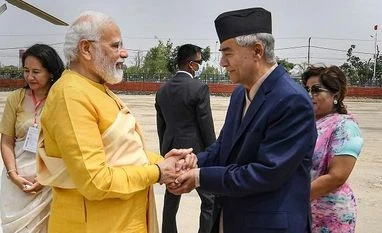
Lumbini: Prime Minister Narendra Modi being greeted by Nepal PM Sher Bahadur Deuba as he arrives in Lumbini, the birth place of Lord Buddha. (PTI Photo/File)
A member of the Eminent Persons' Group (EPG) on Nepal-India relations said on Tuesday that the group has decided to hand over its joint report, charting out a future course for bilateral ties, to the prime ministers of the two countries.
The group which was formed in January 2016 with the mandate to review various aspects of the bilateral relations including Nepal-India Friendship Treaty 1950, said it has worked for about three-and-a-half years to come up with a detailed report and will submit it to prime ministers of Nepal and India soon.
It would not be appropriate to leave it under the responsibility of the coordinators, without handing it over to the two governments, group's Nepal coordinator Bhekh Bahadur Thapa said in a statement.
At an informal meeting held among the members, the group decided that the report would be handed over to the prime ministers of the two countries as soon as possible, and if that was not possible, it would be made public, Thapa said.
A panel of eight members from Nepal and India from diverse backgrounds prepared the Eminent Persons' Group (EPG) report in 2018. While the Indian side was led by former chief minister of Uttarakhand Bhagat Singh Koshiyari, the Nepali team was led by former foreign minister Thapa.
The EPG was formed by the governments of Nepal and India for reviewing the entire gamut of Nepal-India relations and updating bilateral agreements and treaties.
In the ninth EPG meeting in Kathmandu in 2018, it was agreed to replace the 1950 Treaty with a new one, regulate the Nepal-India border by asking citizens to show identity cards while crossing over to either side, and jointly tackle challenges in areas of combating terrorism, extremism, and all kinds of trafficking.
The joint report was prepared years ago, but remains unimplemented.
(Only the headline and picture of this report may have been reworked by the Business Standard staff; the rest of the content is auto-generated from a syndicated feed.)

 "Joint report to be submitted to PMs of India and Nepal: EPG member")

