'Make inspection regime mandatory to prevent car fires'
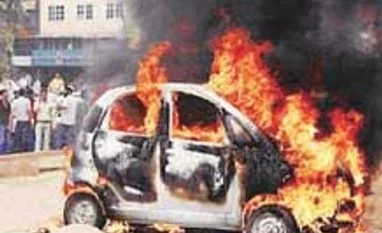
In less than two months, about half a dozen incidents of vehicle fires have been reported in Delhi and Mumbai alone
Swaraj Baggonkar Mumbai Tampering with electrical fittings of a car, subjecting it to improper maintenance or making unwarranted changes to it are the primary reasons behind the spurt in cases of vehicle fires, which have claimed several lives in the recent past.
In a span of less than two months, more than half a dozen incidents of vehicle fires have been reported in Delhi and Mumbai. These incidents have triggered panic among car users.
Sanjay Kulshreshtha, a medical practitioner from Agra, has filed a public interest litigation (PIL) in the Supreme Court, seeking an independent probe into the fires. He has also sought to fix the responsibility of car fires on manufacturers and dealers.
The PIL also sought to impose a ban on convenience features such as power window and central locking in cars.
In Delhi, last Wednesday, two brothers were charred to death when they failed to open the doors of the Hyundai Santro they were travelling in. Last month, a Delhi businessman found the doors of his Toyota Etios jammed preventing his escape, when the fire due to short-circuit gutted his car killing him on the spot.
Kulshreshtha who drives a Maruti Suzuki SX4, has been studying road traffic hazards for seven-eight years and has challenged the lackadaisical approach of the manufacturers. "According to the Delhi Police, at least 35 such fire incidents occur every year in the capital alone. So, we can easily assume that it must be a huge number at national level," argued the PIL.
Car manufacturers, however, claim that most such incidents happen due to lack of genuine maintenance of the vehicle or unwarranted additions made to the car, which could put extra load on the electrical systems of the vehicle.
P Balendran, vice-president (corporate affairs) General Motors, said, "Invariably about 99 per cent of (fire) cases happen because of work done by unauthorised people. Buyers also opt for after-market compressed natural gas (CNG) or liquefied petroleum gas (LPG) fitment or installation of some electronic gadgets not suitable to the vehicle."
Due to their low-operating cost, CNG or LPG became the preferred fuel for many car owners. Roadside garages across the country doubled up as engineers to fix the gas tank in the boot of the car which often lead to haphazard handling of fuel pipes and ignition wires.
An engineer from the Automotive Research Association of India said, "Electrical wires, upholstery made from inflammable material, battery terminals coming loose, ill maintenance of the car can prove hazardous. Manufactures can only do up to a certain extent but the onus lies on the owner as regards to the upkeep of the vehicle. The main culprit here is the some unwarranted tinkering with the electrical fitments, which often go unnoticed by the owner. The illegal retrofitting should be stopped immediately."
S P Singh senior fellow, Indian Foundation of Transport Research and Training, said, "The very procedure of issuing type approvals should be made more stringent. Checks are done by authorities with prior intimation, rather there should be random and surprise testing of vehicles."
Singh is in favour of a mandatory inspection regime for cars like there is for buses, which have to go for annual check-ups. He argues that regional transport offices need to be given greater powers to check the worthiness of vehicles. "Many of the models are more compliant overseas than in India. Product failure is a much larger issue," he points out.
Dilip Chhabria, ace designer and founder of DC Design, said, "Cases of fire always occur due to bad maintenance of the vehicle. The owners generally neglect the car after buying them. At DC Design, we do not do any modifications to the structural or machanicals of the car or we do not disturb any electrical set up in the car. It is only the aesthetic value of the car we change."

 "'Make inspection regime mandatory to prevent car fires'")


 Connect with us on WhatsApp