Home / India News / Modi-Abe meeting: India, Japan slam N Korea over nuclear weapons programmes
Modi-Abe meeting: India, Japan slam N Korea over nuclear weapons programmes
Japan was the only country which openly supported India during the Doklam crisis.
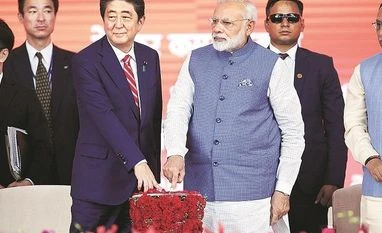
Prime Minister Narendra Modi and his Japanese counterpart Shinzo Abe press a button at the groundbreaking ceremony for a high-speed rail project in Ahmedabad. Photo: Reuters
India and Japan today discussed a host of issues of regional and global importance and strongly condemned North Korea over its continued development of nuclear weapons and ballistic missile programmes, said a senior government official.
Briefing the media after the talks between Prime Minister Narendra Modi and his Japanese counterpart Shinzo Abe here, Foreign Secretary S Jaishankar said the recent Doklam stand- off between India and China was not discussed specifically by the two leaders.
"Doklam was not specifically mentioned in the statement. But all important regional and global issues were discussed," Jaishankar said.
Japan was the only country which openly supported India during the Doklam crisis.
The two leaders condemned, in the strongest terms, North Korea's continued development of nuclear weapons and ballistic missile programmes, the foreign secretary said.
"On the recent developments in North Korea, Japan and India stand firm on their resolve to force the country to change its course of action and fully comply with the UNSC resolution (calling for a halt to nuclear weapons and missile programmes)," the statement said.
Modi and Abe affirmed a strong commitment for a "free, open and prosperous" Indo-Pacific region. However, there was no mention of the South China Sea in the document, unlike last year's joint statement.
"When we talk of the Indo-Pacific region, the South China Sea is a part of it. This is not a position specific to any geography, this is our principled position regarding any part of the world," Jaishankar said when asked why the South China Sea was not mentioned in the statement.
He said the two leaders decided to continue with the talks on Japan's sale of US-2 amphibian aircraft to India, adding that New Delhi and Tokyo also decided to increase the cooperation between the Indian Army and Indian Air Force and their Japanese counterparts.
Till now, defence cooperation between the two countries was largely restricted to their naval forces.
"These are serious discussions (going on). I am not in the know of what the issues are as I am not one of the negotiators," Jaishankar said, in reply to a question on the delay in sealing the US-2 amphibian aircraft deal.
At his briefing, the Director General of Press and Public Diplomacy of Japan, Norio Maruyama, when asked about Doklam, said, "Important strategic issues concerning India were discussed, but I will not name them.
Asked why the South China Sea was not mentioned in the joint statement, he said, "What is important is the spirit of the statement."
Maruyama said the two countries proposed to improve the connectivity between Asia and Africa and promote the stability and prosperity of the region as a whole.
Japan had agreed to push for development in India's north-east and signed an agreement for road connectivity improvement in the region, Jaishankar said.

 "Modi-Abe meeting: India, Japan slam N Korea over nuclear weapons programmes")


 Connect with us on WhatsApp