Modi wants to end India's election cycle; how will simultaneous polls help?

Modi argued simultaneous elections will save time and money, while allowing political parties to focus on policy and governance
Rajasthan bypolls,Ajmer ,Alwar,Mandalgarh Assembly seat,Bharatiya Janata Party,BJP,Congress,Gopal Malviya, Election Commission,Sanwar Lal Jat,Mahant Chand Nath, Kirti Kumari ,EVMs , Rajput community
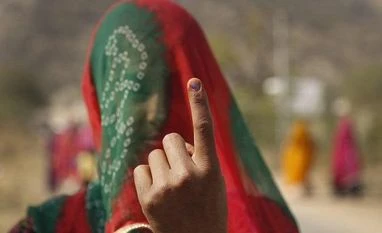
A woman shows her finger marked with indelible ink after casting her vote during by-election for parliamentary seat at a village near Ajmer Photo: PTI
Bloomberg
Last Updated : Apr 19 2018 | 8:12 AM IST
Prime Minister Narendra Modi wants to end India’s relentless election cycle, where about six states go to the polls each year.

The country’s Law Commission, which provides advice to the government, backs the initiative and said simultaneous elections for the lower house of parliament and state assemblies could be held in two phases starting in 2019. Its recommendations come months after Modi and President Ram Nath Kovind pitched the idea.

Joint elections would require constitutional amendments as well as ratification by the majority of India’s 29 states, the Commission said in a draft working paper released on Tuesday. Yet given it took more than a decade to build consensus among states for the launch last year of a nationwide sale tax, getting state leaders on board for this electoral reform could prove difficult.

Modi argued simultaneous elections will save time and money, while allowing political parties to focus on policy and governance. But critics warned the move was a threat to democracy and would curtail the legislature’s power to unseat a government.

“This will destroy the federal structure of the country and will go against the interests of regional parties,” because federal elections would overshadow state polls, said Sanjay Kumar, director of the New Delhi-based Centre for the Study of Developing Societies.

Election Calendar Until Mid-2019

State  Assembly tenure ends  Tentative polling date  Karnataka May 28 2018 May 12 2018  Mizoram  Dec 15 2018 Dec 2018 Chhattisgarh  Jan 5 2019 Dec 2018 Madhya Pradesh  Jan 7, 2019 Dec 2018 Rajasthan  Jan 20 2019 Dec 2018 Sikkim  May 27 2019 April/May 2019 Arunachal Pradesh June 1 2019 April/May 2019 Federal election  June 3 2019 April/May 2019 Telangana  June 8 2019 April/May 2019 Odisha  June 11 2019 April/May 2019 Andhra Pradesh  June 18 2019 April/May 2019

Elections were held concurrently for nearly two decades after 1951. The practice was disrupted in the late 1960s with the premature dissolution of some state assemblies.

In its recommendations, the Law Commission said a second phase of simultaneous polls could take place in 2024, after the synchronization of state election cycles. The government’s policy body, Niti Aayog, suggested in January 2017 that extending and curtailing the duration of some state assemblies would allow half the provincial elections take place along with the federal parliament in 2019, followed by the rest in 2021.

But states ruled by India’s powerful regional parties could complicate those plans.

“The way regional parties are reasserting their federal autonomy and political independence, holding simultaneous polls by 2019 looks a bit difficult,” said S. Y. Quraishi, India’s former chief election commissioner. “Building political consensus has become tougher," he said.

According to a study published by the IDFC Institute, there was a 77 percent chance an Indian voter would support the same party at federal and state level if elections were held simultaneously.

Managing joint elections would cost about 45 billion rupees ($685 million), Niti Aayog said, citing the Election Commission of India. The country spent about 38.7 billion rupees on the 2014 general election, while each state assembly election costs as much as 3 billion rupees, its report said.

"Its an extremely laudable move by the government," said Ajay Bodke, chief executive officer at Mumbai-based Prabhudas Lilladher Pvt. "Besides saving poll expenditure, it will help the government by shifting focus from continuous electioneering to the delivery of promises made to electorates."

One subscription. Two world-class reads.

Already subscribed? Log in

Subscribe to read the full story →
*Subscribe to Business Standard digital and get complimentary access to The New York Times

Smart Quarterly

₹900

3 Months

₹300/Month

SAVE 25%

Smart Essential

₹2,700

1 Year

₹225/Month

SAVE 46%
*Complimentary New York Times access for the 2nd year will be given after 12 months

Super Saver

₹3,900

2 Years

₹162/Month

Subscribe

Renews automatically, cancel anytime

Here’s what’s included in our digital subscription plans

Exclusive premium stories online

  • Over 30 premium stories daily, handpicked by our editors

Complimentary Access to The New York Times

  • News, Games, Cooking, Audio, Wirecutter & The Athletic

Business Standard Epaper

  • Digital replica of our daily newspaper — with options to read, save, and share

Curated Newsletters

  • Insights on markets, finance, politics, tech, and more delivered to your inbox

Market Analysis & Investment Insights

  • In-depth market analysis & insights with access to The Smart Investor

Archives

  • Repository of articles and publications dating back to 1997

Ad-free Reading

  • Uninterrupted reading experience with no advertisements

Seamless Access Across All Devices

  • Access Business Standard across devices — mobile, tablet, or PC, via web or app

Next Story



