The second phase of Delhi government's odd-even scheme starts from Friday and will continue for a fortnight. Delhi Chief Minister Arvind Kejriwal has already announced guidelines for the second leg of the road-space rationing scheme in Delhi.
According to the notification issued earlier this month, four-wheelers with odd registration numbers will be allowed to ply on odd dates (April 15, 19, 21, 23, 25, 27 and 29) and those with even registration numbers on even dates (April 16, 18, 20, 22, 26, 28 and 30). There will be no restriction on Sundays (April 17 and 24).
What's new
Schools will be open this time around. So, all vehicles carrying students in school uniform will be exempt under the second phase.
Additionally, two helplines – 01142400400 and 01141400400 – would be operational during the scheme.
What stays the same
CNG-driven cars and vehicles being driven by women with women or children as passengers will remain exempt. Additionally, like in the first phase, vehicles of the President, Prime Minister, chief ministers and governors of all states, chief justices of India and high courts, speakers of the Lok Sabha and chairman of the Rajya Sabha and leaders of Opposition in both Houses, Union ministers, emergency and enforcement vehicles like ambulance, fire brigade, police will remain exempted from the scheme.
Like the first phase between January 1 and 15 this year, two-wheelers are also exempt from the scheme.
Besides, Delhi's Chief Minister and ministers will continue to be unexempted from the odd-even restrictions.
Penalties
Like the last time, violators will have to shell out Rs 2,000. The original leg of the scheme saw 9,144 challans issued against violators, 2,889 of which were issued by the Delhi Traffic Police and 6,255 by the transport department and sub-divisional magistrates.
Empty gesture or meaningful policy
When the first phase of the scheme came to an end on January 15, it was found that peak pollution had been controlled despite fog and adverse weather conditions.
Additionally, the load of particulates and nitrous oxides from cars had been reduced by about 40%. Furthermore, areas with higher car density recorded more improvement in air quality.
However, the verdict was split on the overall effect the scheme had on pollution levels in Delhi.
The Council on Energy, Environment and Water measured air quality and traffic volumes at five important locations in the city. It said that air pollution levels "increased" in the first week of January, and in the second week, despite there being marginally better air quality, levels still remained poor.
In sharp contrast to the council's findings, Delhi's Transport Minister Gopal Rai had said that air pollution declined by 20-25% in the national capital during the implementation of the scheme from January 1 to 15.
Stating that the maximum PM 2.5 level (particulate matter with diameter below 2.5 microns, responsible for pollution) in December, 2015, was above 600 micrograms/m3 and the average was above 400 micrograms/m3, Rai, highlighting the impact on pollution based on air samples collected during the implementation of the scheme, had said, "In inner Delhi, the average PM 2.5 level was around 300 micrograms/m3. However, it remained around 400 micrograms/m3 in border areas."
How effective, in the long run, will trying to control air pollution by restricting the number of cars on the road be remains to be seen.
However, according to an apportionment study commissioned by the Delhi government and conducted by IIT Kanpur (quoted in a recent media report), cars contribute less than 10% of particulate matter; the bigger culprit are heavy trucks.
Another study conducted by Indiaspend.com seems to confirm this. It says trucks contribute 46% of PM10 and 38% of NOx (nitrogen oxide), while light commercial vehicles account for 28% of PM10 and 13% of NOx in the city’s air. Besides, a major factor for Delhi’s air pollution is its road dust, which contributes nearly 35% of PM2.5.
Either way, during the second phase, the Delhi Pollution Control Committee will monitor the ambient air quality at 119 locations in Delhi and NCR.

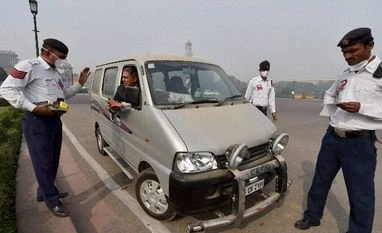 "Odd-even phase-2: What's new and what remains unchanged")


 Connect with us on WhatsApp