Omicron scare in China's Tianjin close to Beijing ahead of Winter Olympics
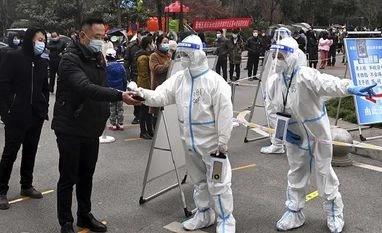
China scampered to test 14 mn residents of Tianjin as the port city near the capital has set off alarm bells ahead of the next month's Beijing Winter Olympics by reporting a cluster of Covid-19 cases
Press Trust of India Beijing China on Sunday scampered to test 14 million residents of Tianjin as the port city near the capital has set off alarm bells ahead of the next month's Beijing Winter Olympics by reporting a cluster of COVID-19 cases, including two with the dreaded Omicron variant.
Thousands of people commute between Tianjin and Beijing as it takes hardly 30 minutes by the high-speed train.
Officials said that Tianjin, a municipality that neighbours Beijing, has decided to start a citywide nucleic acid testing after 20 people tested positive for COVID-19.
The infections were reported on Friday and Saturday in Jinnan district and the gene sequencing found the first two locally-transmitted confirmed cases were infected with the Omicron variant, the municipal headquarters for COVID-19 prevention and control said on Sunday.
Tianjin was the first Chinese city to report a few cases of Omicron in mid-December but not much was heard of its spread since then while major spike in cases was reported from the tourist city of Xian and a few other cities, prompting officials to resort to mass testing.
Besides the two Omicron cases, 18 other infections in Tianjin are mainly students and their family members related to a day-care centre and a primary school where the first two cases were reported, Gu Qing, director of the municipal health commission, said at a press conference.
This prompted the local officials to resort to mass testing of all the 14 million people before its spread to Beijing as the capital city is set to host the much-advertised Winter Olympics from February 4.
The coronavirus has spread for at least three generations in the latest resurgence, and more cases may emerge, said Zhang Ying, deputy director of the Tianjin city's centre for disease control and prevention.
The citywide nucleic acid testing is expected to be completed in 24 hours in four districts on Sunday and in 12 other districts on Monday, state-run Xinhua news agency reported.
The residents will not be given a green health code until receiving a negative test result, the headquarters said.
Meanwhile, the country's National Health Commission (NHC) reported 165 COVID-19 cases, including 92 locally-transmitted ones.
Of the new local cases, 56 were reported in Henan, 30 in Shaanxi, three in Tianjin, two in Zhejiang and one in Guangdong, the commission said.
It also reported 73 new imported cases in 12 provincial-level regions.
In all, 3,392 patients are still receiving treatment, of whom 26 were in severe condition, it said.
The rising number of cases is a cause of concern as China is poised to hold the 2022 Beijing Winter Olympics in a few weeks' time.
The Beijing Winter Olympics, the 24th edition of the showpiece that started way back in 1924, will be held from February 4 to 20.
Beijing will be the only city in the world to have hosted winter and summit Olympics. The city hosted summer Olympics in 2008.
(Only the headline and picture of this report may have been reworked by the Business Standard staff; the rest of the content is auto-generated from a syndicated feed.)

 "Omicron scare in China's Tianjin close to Beijing ahead of Winter Olympics")

