Delhi this winter has been all about high-profile seminars and conclaves. And, even in a calendar packed with speaking engagements by the powerful and the influential, this particular event, held on Friday, stood out. It was the first major public appearance by Manmohan Singh since he demitted office as the country’s long-time prime minister earlier this year.
The topic of the seminar he was addressing was ‘India’s growth trajectory in a fractured world economy’, a subject, one would think, right up the renowned economist’s alley. Fellow panelists included Reserve Bank of India Governor Raghuram Rajan, and UK economist-author of Indian origin, Meghnad Desai. So, anticipation was high in audience, a mix of business people, economists, academicians, journalists, and students. There were some in the audience, present company included, who assumed Singh would speak more freely than he was known to, now that he is not bound by office. One even hoped he would take questions, possibly giving his views on what reform measures his successor, Narendra Modi, should pursue.
The venue was a seminar hall in the Delhi office of business chamber Ficci. The hall seats 180 people. There were about 350 in attendance, so the organisers had put extra chairs and projector screens in the common area outside the hall, as well as at an adjoining conference room.
Security was tight – former PMs get ‘Z’ category cover. It took a while to get registered and body searched (twice, quite awkward), before one could get into the hall. And, once inside, the security personnel were not allowing you to exit even to visit the toilet.
Way back in January, when Singh addressed his last press conference as PM, he had said history would be kinder to him than the contemporary media, or the then Opposition. In a way, that statement was to be put to the test. As he walked in, surrounded by suits with earpieces,the packed gathering stood up, some out of respect and others to click images with their smartphones.
As it turned out, that was the only time they stood for him.
As PM, his second term had started with high expectations. Soon, the country would be left disappointed, and that was even before the massive graft scandals, the stuck infrastructure projects, and slowing economy turned public sentiment against his United Progressive Alliance government.
Singh spoke slowly and deliberately for about seven minutes, compared to Rajan who held the audience’s attention for a good 46 minutes. “I was under the impression that I will merely preside over this seminar, without having to make a speech in front of this august audience. And, quite honestly, I have come here to listen to one of the most outstanding economists of our time,” he said, referring to Rajan.” Good start, mischievous sense of humour still there, and immense respect for Rajan coming through.
But the comparisons between the two speakers at the same forum were inevitable. Singh did speak about how the twin peaks of current account deficit and fiscal deficit can be handled imaginatively in the face of low crude oil prices and that the country’s annual growth rate could be eight-nine per cent. However, there was nothing to grab one’s attention and make great headlines for the next day’s editions (excuse me for behaving like a scribe!)
In various editorials and memoirs by colleagues, Singh has been described as being always risk-averse, playing it safe. Exactly what he did on Friday. He stuck to the script, kept his speech short. Gave the audience a few talking points. And, left without answering any questions or mingling with other panelists. Just like his prime ministership, his appearance on Friday, too, started off with a lot of expectations. Yet, by the time it ended, one felt quite underwhelmed.

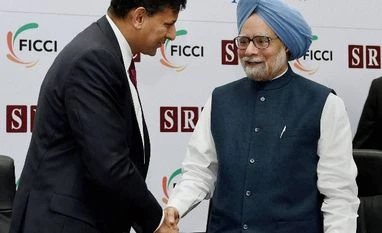 "Post Prime-Ministership, Manmohan Singh still fails to evoke much response as public speaker")


 Connect with us on WhatsApp