Tripura became 'coronavirus-free' - and then cases surged. What happened?

After the first case was detected on April 6, 2 more cases got detected and all recovered by April 23- making Tripura "Corona-free"
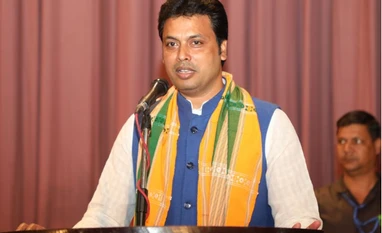
Biplab Deb
While onus to control the spread does depend on individual precautionary measures, the role of the Health Services System is crucial.
Saptadeepa Chakraborty | The Wire
7 min read Last Updated : Aug 06 2020 | 11:05 AM IST
Tripura is one of those few Indian States that has moved from a few cases to being declared “Corona-free”. But back again to a steep rise in the number of cases. The latter made Tripura the northeastern state with maximum prevalence and deaths (after Assam that is going through an added burden of calamities in the face of the pandemic).

After the first case was detected on 6th April, 2 more cases got detected and all recovered by 23rd April- making Tripura “Corona-free”. Only to surge soon after, from 2nd May onwards, in the form of a BSF battalion outbreak in Dhalai district. Non-adherence to social distancing norms was the cause mooted by the Central team investigating the outbreak. The stranded residents from different parts of India were also returning around this time. On June 7 all of the 53 samples testing positive had returned from Chennai by train, taking the active cases toll to 607.

By July 15, positives were being detected among flight passengers, contacts of positive and symptomatic patients, through antigen test and other travellers. This shows how the increasing incidence was also because contacts had started testing positive. Also the current door to door antigen testing (based on presence of symptoms and not confined to returnee or contacts) has yielded many positives in the community. Both are certainly indicative of the surge also being a function of inadequate control of spread in the community.

While onus to control the spread does depend on individual precautionary measures, the role of the Health Services System is crucial in here.

Distribution of COVID-19 care facilities

Until May 11th all of the State’s CC facilities with more than 300 beds were located in West Tripura district.  Epidemiologically speaking, Dhalai then (with more than a hundred active cases) required maximum beds but it had none, although West Tripura with zero cases had more than 300.  Distribution did not quite improve on adding five CCC in five districts because the bed capacity in each was 10 (except Dhalai with 50), as also enumerated in a Bengali daily “Pratibaadi Kalam” (issue of 5th June). On May 19th, a 1000 bedded CCC was proposed in West Tripura, when the latter had zero cases; while Dhalai with 48 active cases had 50 beds. By June 4, Sepahijala district had 38%, Gomati 17% and South Tripura 12% of the active cases in Tripura, but each had only 1-2% of the total COVID beds. But West Tripura with 9% active had more than 80% of the beds.

This skew is not only a wastage of available health resources in each district, but time lapsed to reach patients to West Tripura only potentially prolongs exposure. (For instance, recently, a pregnant woman with COVID had to deliver in the ambulance on the way to GBP Hospital in West Tripura (130 km away) as she was referred from the Unakoti District hospital owing to unavoidable shortage of infrastructure). Besides, this distribution can lead to less severe cases hiding their symptoms to avoid travelling far from home for isolation.

Contextually speaking though, West Tripura has historically had the better quantity and quality of health services, as much as 42.8% of all allopathic institutions in 2007. Current pandemic response has but simulated that situation.

A healthcare worker wearing PPE kit interacts with children at CWG COVID Care Centre, in New Delhi on Saturday

The scale of testing, that is currently known to be the second best in all of India, proved to be ineffective in tracking the spread of infection because of its algorithm. The algorithm of testing iterative with isolation is important because States like Delhi, which has the third highest scale of testing, is apparently picking up only 2.5 to 3% of cases.
 

Initially when residents were only returning by road to Tripura, surveillance strategy was somewhat better as screening based on travel from hotspots and presence of symptoms was being used at the entry point and facility quarantined in the North district (the check-point was also in the same district and therefore close-by). But the hazard was still in sending those from hotspots, but immediately testing negatively, home; as well as the symptomatic but negative from non-hotspot areas. This is because symptom as well as positive viral status is known to vary in onset.

However the hazardous potential truly increased when thousands of residents were returning in trains- first because situational scale of exposure here was possibly enormous and secondly because testing was only being done in a random 1:5 ratio, thereafter mandatorily sending home for quarantine till tests turn positive. Besides, the latter did not apply to all returning by air although many flight passengers were testing positive, as discussed earlier.

Not only does the randomisation have the chance of missing out asymptomatic and pre-symptomatic cases, but sending any incoming individual home (oblivious of the fact that they could be primary or secondary contacts in their incubation period) especially since the State had eliminated COVID-19, was the seed for community transmission. The door to door antigen testing yielding so many positives really bears these possibilities out.
Healthcare workers wearing Personal Protective Equipment (PPE) seen as they screening the residence of a housing colony during a door-to-door campaign for coronavirus testing in Mumbai on Sunday.

Delay in test results

The only laboratory for diagnosing COVID-19 in the entire State is located in the G.B.P. Hospital of West Tripura, having 6 RT-PCR machines although the Government has assured to add three more- two in other districts and one in the private State tertiary Hospital in West Tripura (Dainik Sambad, July 24). This certainly leads to stacking up of samples waiting for being tested as also time lapses while samples are being sent from other districts, and therefore a delay in the results and prolonged duration of exposure.

While concluding, it needs to be highlighted that no amount of “Test-Track-Treat” strategy, however meticulously done, can reduce the surge unless measures of containing the spread are enacted. The way forward really is to start from square one- implementing 14 days lockdown restricting inter and intra-state movement, after isolating all positive cases. Extra beds can be arranged “equitably” in public gathering halls/spaces/buildings across all districts, currently not in use due to the pandemic. While an exemplary step to form community isolation homes was announced by the government, following up was important as a lot of public opposition was encountered initially to setting up of quarantine facilities; these should be compulsorily enforced in the current circumstances.

As the lockdown is lifted all returnees should mandatorily be put into facility quarantine till negative status is confirmed, and not the other way round. Travelling facility can be staggered such that an acute crunch in quarantine facilities does not arise and testing can be done in RT-PCR based pooled samples to be resource intelligent. But all this can only be effective when quarantine facilities are equitably scaled up from the village to the district level, by utilising existing infrastructure.  

Otherwise, it is only a matter of time until the scale of treatment possible in the state will be overpowered by the increasing incidence.

One subscription. Two world-class reads.

Already subscribed? Log in

Subscribe to read the full story →
*Subscribe to Business Standard digital and get complimentary access to The New York Times

Smart Quarterly

₹900

3 Months

₹300/Month

SAVE 25%

Smart Essential

₹2,700

1 Year

₹225/Month

SAVE 46%
*Complimentary New York Times access for the 2nd year will be given after 12 months

Super Saver

₹3,900

2 Years

₹162/Month

Subscribe

Renews automatically, cancel anytime

Here’s what’s included in our digital subscription plans

Exclusive premium stories online

  • Over 30 premium stories daily, handpicked by our editors

Complimentary Access to The New York Times

  • News, Games, Cooking, Audio, Wirecutter & The Athletic

Business Standard Epaper

  • Digital replica of our daily newspaper — with options to read, save, and share

Curated Newsletters

  • Insights on markets, finance, politics, tech, and more delivered to your inbox

Market Analysis & Investment Insights

  • In-depth market analysis & insights with access to The Smart Investor

Archives

  • Repository of articles and publications dating back to 1997

Ad-free Reading

  • Uninterrupted reading experience with no advertisements

Seamless Access Across All Devices

  • Access Business Standard across devices — mobile, tablet, or PC, via web or app

Topics :CoronavirusCoronavirus TestsCoronavirus VaccineTripuraBiplab Deb

Next Story



