Home / India News / Yamuna level breaches 'danger mark'; evacuation begins in low-lying areas
Yamuna level breaches 'danger mark'; evacuation begins in low-lying areas
The Delhi administration on Friday sounded a flood alert and expedited efforts to evacuate people living in the Yamuna floodplains, as the river in the capital breached the danger mark
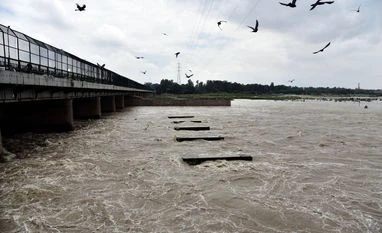
Water level of the Yamuna river rises following rains over the past several days in Delhi.
The Delhi administration on Friday sounded a flood alert and expedited efforts to evacuate people living in the Yamuna floodplains, as the river in the capital breached the danger mark of 205.33 metres amid heavy rains in the upper catchment areas, officials said.
The water level was recorded at 205.59 metres at the Old Railway Bridge at 9 pm. It was 205.34 metres at 11 am and 205.10 metres at 6 am, an official said, adding it is likely to rise further.
All the departments concerned have been alerted. The irrigation and flood control department has deployed 13 boats in different areas and put 21 others on standby, the official from the irrigation and flood control department said.
With Haryana discharging more water into the river from the Hathnikund Barrage, the Delhi Police and the East Delhi district administration have started evacuating people living on the floodplains of the Yamuna in the capital.
These people are being shifted to shelter homes of the city government in the Yamuna Pushta area, the official said. "In the East District, 15 vulnerable points have been identified. We are erecting tents and evacuating people from these vulnerable points," another official said, adding all standard operating procedures are being followed and the situation is being monitored round-the-clock.
A flood alert is declared when the Yamuna crosses the "warning mark" of 204.50 metres. The situation is being monitored round-the-clock, a district administration official said.
The river is in spate because of rains in Delhi and the upper catchment areas, a MeT department official said, adding it may swell further as more rains are predicted in northwest India.
According to the Delhi flood control room, the discharge rate at the Hathnikund Barrage peaked to 1.60 lakh cusecs on Tuesday afternoon, the highest this year so far.
The water discharged from the barrage normally takes two-three days to reach the capital.
Haryana had been releasing water from the Yumananagar-located barrage at the rate of 37,109 cusecs at 8 pm. It was 19,056 cusecs at 8 am.
Normally, the flow rate at the Hathnikund barrage is 352 cusec, but the discharge is increased after heavy rainfall in catchment areas.
One cusec is equivalent to 28.32 litres per second.
In 2019, the flow rate had peaked to 8.28 lakh cusec on August 18-19, and the water level of the Yamuna had hit the 206.60 metre-mark, breaching the danger mark of 205.33 metres.
The Delhi government had to launch evacuation and relief operations after the overflowing river submerged many low-lying areas.
In 1978, the river had swelled to the all-time record water level of 207.49 metres.
In 2013, it had risen to 207.32 metres.
(Only the headline and picture of this report may have been reworked by the Business Standard staff; the rest of the content is auto-generated from a syndicated feed.)

 "Yamuna level breaches 'danger mark'; evacuation begins in low-lying areas")


 Connect with us on WhatsApp