A bureaucracy to match Modi's ambitions
Jyoti Mukul New Delhi When criticism mounted about projects coming to a standstill last year, the Manmohan Singh government sacked one of its Cabinet ministers. The buzz was that the minister had been sitting on clearances and refusing to approve the projects. A few days before the minister was divested of charge, a senior bureaucrat, driven to the wall on the issues that the minister was reluctant to address, sought an audience with a person close to the prime minister. "I did not have direct access to the prime minister. I had to have my message conveyed to him through someone else. It was just a matter of days before the minister was shown the door," says the official. Such is the power of the senior bureaucracy when allowed access to the top man in the government.
But in its last few years in office, the United Progressive Alliance (UPA) government did not accord its bureaucrats such power. There was an air of despondency in the ranks when even retired officials were pulled up for decisions taken by the ministries years earlier. Senior bureaucrats were wary of verbal orders given by the ministers and reluctant to push the files forward. In the UPA government's constant referral of issues to the so-called Empowered Group of Ministers and Group of Ministers (GoM), they saw their own capacity to tackle policy niggles being whittled down.
The mood in the bureaucracy has changed in the summer of 2014. After the victory of the National Democratic Alliance led by Narendra Modi in the general elections, the new prime minister's first major step towards improved administration and governance, taken within a week of assuming office, was to dissolve the battery of GoMs.
The ministries were asked to tackle all contentious issues on their own. The various officials in the ministries were presumably being asked to play a more active role in advising their political bosses while finding solutions to problems. They were also told that in case they faced "difficulties" in ironing out procedural kinks, the Cabinet Secretariat and the Prime Minister's Office (PMO) would facilitate the final decisions.
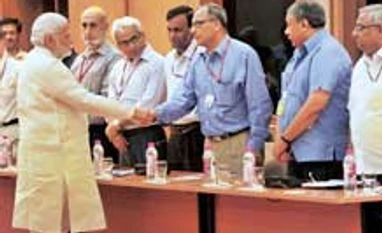
Modi also met the secretaries and emphasised to the assembled bureaucrats that he would be "accessible to all officers" and they could approach him with their inputs and ideas.
The corridors of India's bureaucracy are now abuzz with activity. The secretaries are busy with the PowerPoint presentations they will put up at South Block on the agenda for each ministry, and they will not have their ministers with them when they do it. In a democratic set-up, under the rules of business transaction, ministers formulate the policy and run the country, but bureaucrats administer plans and are direct partners in governance. However, within this system itself, Modi has conveyed the message that if the ministers do not perform then the secretaries have a window of appeal.
A senior official says Modi appears passionate about governance and wants to make a difference to the way administration is handled. "The initial signals given to the bureaucrats are positive, though it is too early to make a judgment on whether this approach will work," says a secretary.
Modi's enthusiasm seems to have percolated down. As one serving secretary says, "If one does not have direct access to the head of the government, then radical changes will never come by." He says hurdles do not matter when one is working in a set-up where the leader takes decisions. "You are enthused and want to perform. But if you know there is no one to carry a decision forward then you lose interest."
Though Modi's interactions with the secretaries are being seen as a positive move aimed at confidence building among bureaucrats, which could also indirectly help to rein in errant ministers, the underlying implication is that the performance of the government's top officials will be under closer scrutiny.
Many see a similarity between Modi's handling of bureaucracy and former prime minister Rajiv Gandhi's style of functioning. Yogendra Narain, former secretary general of the Rajya Sabha who has also been Union surface transport secretary and Uttar Pradesh chief secretary, points out that in Gandhi's case a good beginning was made when he called a meeting of some 600 district collectors. He suggests that Modi should have a written understanding with bureaucrats and their performance judged by the parameters delineated in the agreement. "This will make the functioning of the bureaucracy both accountable and responsible," he says.
The officials perhaps sense a difference in the way the government is functioning now. Says one official: "Unlike the UPA regime, where ministers were running in different directions and working in silos, Modi is a charioteer directing the movement forward." The pace and success of the movement will, however, not be determined by the charioteer alone but by the direction the journey takes and whether the initial euphoria translates into concrete action on the ground.

 "A bureaucracy to match Modi's ambitions")


 Connect with us on WhatsApp