More than 12 million households who contributed more than 130 million person-days to work under the Mahatma Gandhi National Rural Employment Guarantee Scheme (MGNREGS) have not been paid from September because of delays in submission of audit and compliance documents from states.
Inconsistencies and delays in administrative processes at the level of state and the Centre and lapses in coordination have delayed wage payments of Rs 3,000 crore.
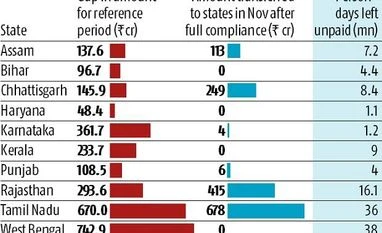
Only those states where more than 75 per cent fund transfer orders (FTOs) were not processed for more than 60 days — Assam, Bihar, Chhattisgarh, Haryana, Karnataka, Kerala, Punjab, Rajasthan, Tamil Nadu and West Bengal — have been considered for this analysis. FTOs are the sanctioned applications that facilitate transfer of wages and funds to beneficiaries and implementing agencies.
States are mandated to submit several documents — audit statements, (fund) utilisation certificates, bank reconciliation certificates, account statements, action-taken reports, various annexures as part of the audit of the previous financial year at the end of September 30 in the current financial year. This gives states six months to complete the process.
In recent weeks, Tamil Nadu, Chhattisgarh, Assam and Rajasthan have received funds from the Centre, reducing the gap in wage payment. But, these fund transfers have come with a month-long lag.
Tamil Nadu (Rs 670 crore for 36 million person-days) and West Bengal (Rs 740 crore for 38 million person-days) accounted for more than half of the nationwide impact of the delay.
The delay from states pertains to starting the audit process on time, adherence to deadlines, coordination between constituent districts and auditors and the complexity resulting from the amount of data involved.
The second tranche of funds is released to states, and wage payments done through national electronic fund management system, only after successful submission of the documents. Most documents are electronically generated through online systems. But states have to compile them, appoint auditors and complete the audit before September 30.
“It is a mammoth exercise to audit thousands of projects involving millions of workers in hundreds of blocks in a state,” an official from the rural development department of West Bengal told Business Standard. “Further, unlike many states where the block is the implementing agency, village panchayat is the implementing agency in our state, making our work more decentralised but cumbersome.”
The delay on the part of the Centre was due to the time taken for scrutiny of audit documents. “We submitted the documents on October 5, and we received funds only in the first week of November,” Muthuminal, NREGA coordinator with the Tamil Nadu government, said.
Operational guidelines of the scheme state: “If the district achieves 60 per cent expenditure level after the 30th day of September in a FY, the district needs to submit audit report (AR) of the previous FY to the state, in addition to the compliance of all prerequisites under MGNREGA. The software has in-built provisions to capture details of the ARs. The software will, as in the case of districts, generate alerts and list out deficiencies in the fund release proposal of the state by auto-analysing data submitted by the districts.”
Bihar, on its part, experienced floods during the monsoon, and saw administrative delays. “Due to flash floods in Champaran and other areas, our administrative machinery was focused on flood relief. We are now receiving complaints from workers, but money is not yet available from the Centre,” A K Chaudhary, NREGA commissioner of Bihar, said.
Karnataka, too, submitted all compliance documents on October 31, but has not received wage payments till date. “The documents are currently with the internal finance department of the rural development ministry, and we are hopeful that workers will receive the delayed wages soon,” Hanumant Gowda, financial advisor to the directorate of NREGA in Karnataka, said.
The delay recorded by the MGNREGA division of the rural development department takes into account the delays caused after FTOs have been sanctioned. In this case, where FTOs have not been sanctioned, workers are not eligible for delay compensation of 0.05 per cent of accumulated wage amount per day.

 "Administrative lapses delay job scheme pay")












 Connect with us on WhatsApp