
Atomic energy board clears construction of Kudankulam 3&4 units
Those against the project claim that the clearance is illegal by AERB's own guidelines
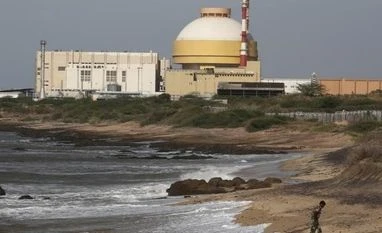 "Atomic energy board clears construction of Kudankulam 3&4 units")
premium
WebinarsNew
Deep DiveNew
Explore Business Standard
Those against the project claim that the clearance is illegal by AERB's own guidelines
The AERB said in an announcement that it had granted FPC clearance to Nuclear Power Corporation of India Ltd (NPCIL), at a meeting held on June 19. In general terms, the FPC clearance implies commencement of first pour of structural concrete and continuation of construction works of the safety related structures.
KKNPP-3 and 4 are two units of VVER (Russian) pressurised water reactors to be constructed at Kudankulam, Tamil Nadu. These reactors are repeat designs of KKNPP-1 and 2 with improvements based on commissioning and operational experience feedback from the two existing units.
"The FPC clearance for KKNPP-3&4 is granted based on detailed safety review and satisfactory compliance to regulatory requirements," said A U Sonawane, head, radiological safety division and external relations officer (ERO), AERB in an announcement. At present, the excavation of the main plant area of these two units is complete and is ready for construction activities.
Activists of Poovulagin Nanbargal, an environmental organisation that has been legally fighting against the project, said that the clearance is completely illegal by its own guidelines, as the population in the sterlised zone is atleast 40 per cent higher than the stipulated guidelines. There are many more flaws in the approval granted including the EIA done by an unaccredited agency, it alleged.
"We strongly urge that the FPC be cancelled and will hold the Tamil Nadi Government responsible for agreeing to this illegality," said G Sundarrajan, a leader of the organisation.
Units 3 and 4 of KNPP, with 2x1,000 Mw capacity, are expected to come up with an investment of around Rs 39,747 crore. The site was found to have an optimum potential for locating six units each of 1,000 Mw by the Site Selection Committee of the Government. The Government accorded 'in principle' approval for setting up of Units 5&6 at Kudankulam in October 2009.
According to reports, India and Russia has also finalsed the general framework agreement and a credit protocol for Unit 5 and 6.
The first unit of 1,000 Mw in KNPP went critical in July 2013 and was dedictated to the country by both the leaders in August 10, 2016. The second unit of 1,000 Mw achieved criticality on July, 2016 with its full capacity, the total atomic power capacity in Tamil Nadu is to be 2,440 Mw.
Already subscribed? Log in
Subscribe to read the full story →

3 Months
₹300/Month
1 Year
₹225/Month
2 Years
₹162/Month
Renews automatically, cancel anytime

Premium stories handpicked daily by our editors


News, Games, Cooking, Audio, Wirecutter & The Athletic
Digital replica of our daily newspaper — with options to read, save, and share


Insights on markets, finance, politics, tech, and more delivered to your inbox
In-depth market analysis & insights with access to The Smart Investor


Repository of articles and publications dating back to 1997
Uninterrupted reading experience with no advertisements


Access Business Standard across devices — mobile, tablet, or PC, via web or app
First Published: Jun 24 2017 | 5:28 PM IST

