Arianespace to launch India's Insat-3D spacecraft on July 26
India has also contracted Arianespace to launch (expected in August) GSAT-7, a multiband satellite carrying payloads in UHF, S-band, C-band and Ku-band
Press Trust Of India chennai/ Bangalore European space consortium Arianespace would launch India's Insat-3D, an exclusive meteorological satellite, from its spaceport of Kourou in French Guiana on July 26.
Insat-3D is configured with advanced meteorological payloads - a six Channel Imager, 19 Channel Sounder along with data relay transponder and satellite aided search and rescue payloads, an official of Indian Space Research Organisation (ISRO) said here today. "The spacecraft platform is adopted from the standard I-2K bus with a power handling capability of around 1,100 W with a lift off mass of 2,090 kg," the official said.
India has also contracted Arianespace to launch (expected in August) GSAT-7, a multiband satellite carrying payloads in UHF, S-band, C-band and Ku-band.
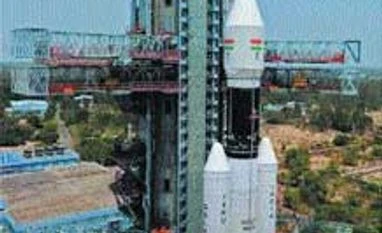
The satellite employs the standard 2,000 kg class bus (I-2K) platform with power handling capability of around 3000 W and lift-off mass of 2,550 kg. ISRO sources said preparations are on at the second launch pad at the spaceport of Sriharikota for the launch of GSLV-D5 (Geosynchronous Satellite Launch Vehicle-Development flight 5) in August.
GSLV-D5 aerodynamic characterisation has been revisited following the back-to-back failure of GSLV flights - one with indigenous cryogenic engine and another with a Russian-made one in 2010. Force measurements, steady and unsteady pressure measurements and aero elastic tests have already been conducted using wind tunnel models at National Aerospace Laboratory, Bangalore and Glavkosmos, Russia.
Computational fluid dynamics simulations have been carried out in-house for incremental effects on protrusion, overall aerodynamic load distribution and distribution on protrusions, according to ISRO. GSLV-D5 would carry GSAT-14 satellite with six extended C band and six Ku band transponders, envisaged to enhance communication transponder capacity.
The satellite employs the standard 2,000 Kg class bus (I-2K) with a power handling capability of around 2.5 KW and a lift-off mass of 1,980 kg, the space agency added.

 "Arianespace to launch India's Insat-3D spacecraft on July 26")

