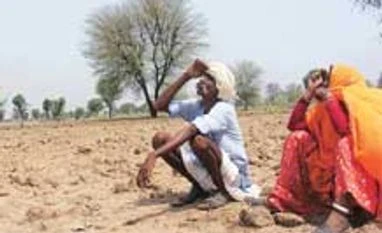
Khajura Ram has an agonising fortnight ahead. If it does not rain in the next 15 days, he not only will have a poor summer bajra crop; his winter wheat or mustard will suffer as well because it will have to be planted late.
"By the middle of August, the bajra crop should have been ready for harvesting but this year, it is not even four ft tall. The yield will be less than half. If rain does not improve by the end of August, the next crop will suffer, too," says the 70-year-old farmer in Rajasthan's Nangalhera village, 40 km from Alwar, pointing to unsown patches and a half-grown crop on his five acre farm.
Khajura Ram fears more the impact of an uneven monsoon on wheat, chana and mustard, sowing for which, he says, starts immediately after Diwali. These crops are the money spinners. "Bajra is sold at Rs 800 a quintal, but wheat sells at over Rs 1,400," he says. Khajura Ram's income this year could halve.
The monsoon typically starts retreating from north India by September. Since June, when the season began, Nangalhera has received only five or six days of good rain, nowhere near what is needed for a decent summer harvest.
"I had sown bajra around July 6 but look at its condition. In a month, it has not even reached the flowering stage. If this crop is not harvested before September, my next crop will be delayed," says 60-year-old Kirori Ram, Khajura Ram's half-brother who shares the farm with him.
Rajasthan has become one of the main producers of wheat in the country over the past few years and in the previous season, the central government bought 2.2 million tonnes from the state, two-thirds as much again as in 2012. Mustard, the prime cash crop cultivated in the Alwar region, is the single biggest source of high farm earnings.
Sudhir Panwar, a professor at Lucknow University and president of the Kisan Jagriti Manch, a farmers' activist group, says the winter crop is vulnerable in areas without irrigation because a weak monsoon lowers the moisture content of the soil.
"The biggest impact should be on mustard in Rajasthan, which is mostly grown without irrigation," Punwar says and suggests farmers here might have to switch to short-duration crops that need less water.
The cost of irrigation in the state is climbing as wells and small canals dry up, forcing farmers to sink bore-wells. A bore-well of average depth costs Rs 10 lakh, which could go up if the water level dips.
"Last year, we found water at 400-500 ft. This year, clean water is not available till 700 ft," Kirori Ram says, pointing to his freshly watered farm. The old bore-well in a corner of the field is covered with a plastic sheet, a new one 10 ft away throws up a thick column of water.
Haji Gafoor of Chilkanabaas, another village near Alwar, says a few years ago, water from traditional wells was enough for crops and humans. In the past five years, groundwater has dipped alarmingly and these wells are now used only for drinking water. "We have to rely on bore-wells to water our fields but these are becoming more expensive each passing year," says Gafoor.
With rain fading, other costs rise as well. "Had it rained properly, six workers were enough for a farm of bajra. Now, we have to hire 10 labourers. Typically, a farmhand charges Rs 300 a day now," says Nathuram Gothwal, another Chilkanabaas farmer.
Five years ago, the price of a farmhand was Rs 150 a day in Alwar but government schemes like the Mahatma Gandhi National Rural Employment Guarantee Act have doubled rates. "Apart from high wages, workers want fixed hours with a refreshment break. If we don't accept their terms, they have better options," says Gothwal.

 "Big monsoon picture masks agony on the small farm")

