As Karnataka, Madhya Pradesh, Rajasthan, and Chhattisgarh — all agriculturally significant — go to the polls next year, the Centre is looking at a revamp of its tariff policy on exports and imports of farm produce with a focus on protecting the interests of farmers.
Relative stability in the production of oilseeds, pulses, cereals, and, to some extent, vegetables, despite two drought years, has prompted the government to rethink its strategy.
The earlier approach, which leaned heavily on protecting the interests of consumers, kept farm prices low, a choice many experts blame for the BJP’s not so impressive performance in the elections in parts of rural Gujarat.
Senior officials said the government would be bold and quick to hike import duties on commodities whose prices had fallen by a big amount or push exports.
The process of tweaking duties started a few months ago, with the government doubling the import duty on wheat, followed by doubling the import duties on crude edible oils and pulses like yellow peas, gram, and masoor, imposing stiff import duties on sugar, and opening up exports of all varieties of pulses for the first time in a decade.
The steps seem to have some impact on prices because after the duty on crude edible oils was doubled in November, soybean seed prices in Madhya Pradesh have moved up from around Rs 2,770 per quintal to nearly Rs 3,020 per quintal, which is near the minimum support price (MSP) of Rs 3,050 per quintal.
The price of refined soyoil during this period had moved up from Rs 67,800 per tonne to Rs 72,300 per tonne, before dropping to around Rs 71,700 per tonne.
Senior officials said the measures taken in the last few months were just the beginning and the government would not shy away from taking tough decisions to protect the interests of farmers.
It is also looking at a big thrust on exports of agricultural commodities. Recently, the commerce ministry deliberated with state representatives to identify clusters that could be developed for boosting exports and also devising a strategy for it.
“The experience of the past few years has shown us that the production of major agricultural commodities like oilseeds, pulses, cereals, and also vegetables, to some extent, is no longer a big problem in India. The idea now is to ensure that farmers get remunerative prices for their produce and one way to do that is to curb cheap imports along with opening up new avenues of exports,” a senior official said.
He said despite two big back-to-back droughts, along with other natural calamities in some parts, pulses output has gone above 21 million tonnes, while oilseeds production hasn’t fallen much below 31 million tonnes. Cereals like wheat, rice, and maize too haven’t seen a big fall in output, and the same has been the case with many vegetables.
The data from the Directorate General of Commercial Intelligence and Statistics, under the ministry of commerce and industry, shows India’s exports of agri and allied products declined by 25 per cent to $24.7 billion in 2016-17 as against nearly $33 billion in 2013-14.
In contrast, imports of agriculture and allied products jumped in the same period to $23.2 billion from $13.5 billion.

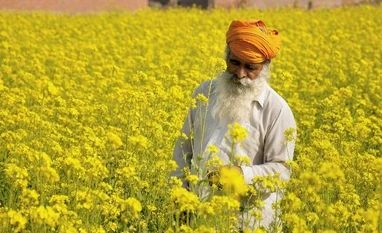 "Centre looks at tweaking trade tariffs to boost farm incomes")












 Connect with us on WhatsApp