Changing jobs? Here's how to file your income tax returns

It's better to inform new employer about income earned and deduction availed with the previous one
graph
Tinesh Bhasin Mumbai
Last Updated : Jun 07 2017 | 2:11 AM IST
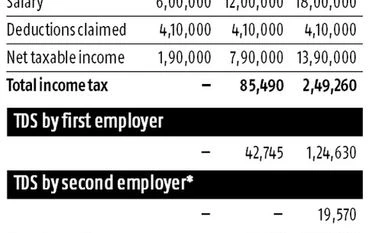
If you have changed jobs in the previous financial year, filing the income tax return could be complex, as you will have two Form 16s to deal with. In case the new employer was not updated about the deductions claimed in the previous company, you may have significant outstanding tax liability while filing returns. 

Employees usually declare their tax-savings investments and other deductions to both the employers, but they don’t realise this can change the tax computation. Vikram Ramchand, co-founder, Makemyreturns.com, says there’s Rs 1.5 lakh tax deduction available under Section 80C, Rs 2 lakh deduction on home loan interest, a basic exemption limit of Rs 2.5 lakh and another Rs 50,000 for investments made in National Pension Scheme (NPS). Just these major deductions amount to Rs 6.5 lakh. “If both the old and the new employer consider these deductions, that can even change the individual’s tax slab,” says Ramchand.

Those who have changed jobs need to prepare a statement of total income and tax liability to make sure that tax is calculated according to the correct slab. For this, they need to consolidate the salaries earned from both the employers in that financial year. Ensure that you have Form 16 from both the companies as these will show the various components employers have considered to calculate your tax liability and have accordingly deducted tax. If you cannot get Form 16 from the previous company, use your salary slips. You can also get details of tax deducted at source by referring to Form 26AS, available at the e-filing website of the income tax department. Then calculate the tax liability you may have.


If you earn Rs 12 lakh a year, your tax liability comes to around Rs 56,200 if you take advantage of Section 80C, medical insurance deduction, NPS and home loan. But, if you changed job mid-year and both employers consider these deductions and exemptions, your tax liability will be negligible. “In cases where an employee is getting the tax deduction benefit twice, he needs to calculate the tax liability and pay advance tax for all the instalments which may fall due after he joins the new employer, or else there will be interest charged on the tax outstanding under Section 234B and 234C,” says Naveen Wadhwa, a chartered accountant with Taxmann.com.

If the calculation gets too complicated for you, approach a chartered accountant. You can also go to platforms that help with tax filing. All of them allow you to upload multiple Form 16s. The software then automatically calculates your tax liability and shows whether you have an outstanding. Some of these platforms let you use the facility for free if you opt to file taxes on your own.

In future, to avoid such a situation, it’s better to inform the new employer about the income earned and deduction availed with the previous one. Submit Form 12B with complete details of your salary, deductions and TDS from earlier company. Form 12B helps the new employer furnish a consolidated Form 16 at the end of the year based on the details provided. 

One subscription. Two world-class reads.

Already subscribed? Log in

Subscribe to read the full story →
*Subscribe to Business Standard digital and get complimentary access to The New York Times

Smart Quarterly

₹900

3 Months

₹300/Month

SAVE 25%

Smart Essential

₹2,700

1 Year

₹225/Month

SAVE 46%
*Complimentary New York Times access for the 2nd year will be given after 12 months

Super Saver

₹3,900

2 Years

₹162/Month

Subscribe

Renews automatically, cancel anytime

Here’s what’s included in our digital subscription plans

Exclusive premium stories online

  • Over 30 premium stories daily, handpicked by our editors

Complimentary Access to The New York Times

  • News, Games, Cooking, Audio, Wirecutter & The Athletic

Business Standard Epaper

  • Digital replica of our daily newspaper — with options to read, save, and share

Curated Newsletters

  • Insights on markets, finance, politics, tech, and more delivered to your inbox

Market Analysis & Investment Insights

  • In-depth market analysis & insights with access to The Smart Investor

Archives

  • Repository of articles and publications dating back to 1997

Ad-free Reading

  • Uninterrupted reading experience with no advertisements

Seamless Access Across All Devices

  • Access Business Standard across devices — mobile, tablet, or PC, via web or app

Next Story


