US Commerce Secretary Wilbur Ross stayed in India for just two days. But apart from hogging headlines by hitting out at India repeatedly, the hardline Trump Cabinet member also convinced Indian trade negotiators that recent trade spats with the US will take a long time to resolve.
During his visit, Ross met both Commerce and Industry Minister Suresh Prabhu and Prime Minister Narendra Modi, raising the issue of high tariffs and market access barriers, a pet peeve of the Trump Administration. However, he spent most of the visit training his guns on regulatory challenges in India, calling them “unnecessarily complex and discriminatory”. The comments have sparked a debate, marking a rare departure from previous bilateral visits when senior US government figures had complimented the Modi regime for augmenting ease of doing business and opening up a majority of the sectors to foreign direct investment.
Although he managed to turn a profit, cashing out with $127 million, Ross was reportedly irritated at not being able to remain in the sector for long and make a bigger profit. As the aviation industry took off in India over the subsequent decade, Ross has continued to blame the heavy-handed approach to the private sector by the government for his early exit, sources at the US Department of Commerce say.
Before this, the investment firm founded by Ross in 2000 had acquired apparel maker OCM India for about $37 million in 2016. The firm was in talks with China’s textile major Shandong Ruyi Technology Group to sell its entire stake, but finally sold to Mumbai-based Donear Group, another textile manufacturer, in late 2017.
After being pulled up by US securities watchdog for having potential conflict of interest as commerce secretary, Ross had pledged to sell his stake in WL Ross & Co. that earlier independently managed more than $4.1 billion worth of investments. However, he continues to face a string of serious allegations for securities fraud, embezzlement, and corruption that deem more than $120 million of his estimated $700 million fortune as ill-gotten wealth. Ross doggedly continues to defend himself in all cases, arguing that his investments were complex and self reporting each to the government took time.
Ross’s financial dealings have made him fair game for the Opposition Democratic Party, which has charged him for being ‘part of the rot’ of Wall Street financiers and high-profile company executives with whom Trump has crammed his Cabinet. A case in point: Ross is also mentioned in the infamous Paradise Papers — a global financial database leak that shows where the wealthy and powerful have stashed their cash.
In 2006, Ross sold a controlling stake in his investment management fund to a larger company called Invesco for $100 million. But later, Invesco had to pay $43 million in fines and reimbursements after creditors complained of Ross repeatedly charging inappropriate fees on failing investments and collecting money for serving on corporate boards in violation of his agreement with his investors. Even as the US commerce secretary berated the Indian government for a lack of transparency, the little known fact is that WL Ross & Co. continues to have a subsidiary in Mumbai, with authorised share capital of Rs 3 crore, of which capital is more than Rs 2.3 crore.

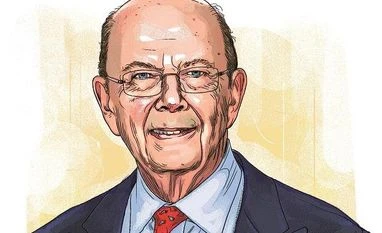 "Deep and personal: Why Wilbur Ross hates Indian business regulations")












