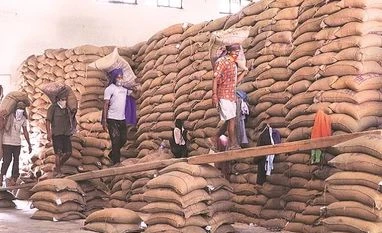
The agency that runs the world's largest food welfare programme is facing a problem that stands testimony to its size. Expanding its procurement every year, the Food Corporation of India (FCI) has been caught in a situation in which it has lifted excess food that it will find difficult to put it to use, once the requirement of India’s poor has been met.
Last year (2020-21), the FCI and state agencies procured more than 132 million tonnes (mt) of cereals from Indian farmers at the minimum support price (MSP), consisting of 89 mt rice and 43 mt wheat. This was twice the average procurement of a decade ago. As a result, FCI had a record 110 million tonnes of rice and wheat in its stock this summer (including rice from unmilled paddy), or 2.5 times the buffer norm of 40 mt.
On the other hand, the annual requirement under the National Food Security Act (NFSA) is not more than 65 million tonnes. At older levels of procurement, disposing off 65 mt for India’s food security did not entail too much of lying stock. Having procured nearly twice the requirement, the FCI is left with record stocks and limited options to dispose them.
The corporation is well aware of this supply-demand imbalance, and discussions on how to handle such a recurring situation with the correct use of unused food stocks are already underway, chairman Atish Chandra told Business Standard.
“The FCI and the Department of Food and Public Distribution are brainstorming over a range of measures to dispose of stocks to avoid an oversupply situation. A micro-analysis of state wise requirements and buffer norms—whether they need to be changed—is underway,” he said.
The pandemic period did offer a short-term solution. Under the Pradhan Mantri Garib Kalyan Anna Yojana (PMGKAY), the government provided free cereals to millions of households, and that took up a big slice of the food available with FCI—31 million tonnes in 2020-21, and eight mt in the first three months of 2021-22.
Note, that the record 2021 summer stocks of more than 100 mt are despite the 31 mt free giveaway under PMGKAY. But again, this is only a temporary measure: PMGKAY is not a permanent scheme.
In fact, the giveaway under the temporary scheme will be smaller in 2021-22, but the procurement of paddy and wheat may again be a record this year.
“We are expecting a similar build up of food stocks in the summer of 2022 as well, and hope to have a system in place to absorb the stocks by then,” Chandra told Business Standard.
He also said that FCI is doubling its efforts to do more open market auctions of stocks this time. “We are eyeing 8-10 mt of open sale this year.” This may or may not solve the problem, as the excess stock is considerably more than this.
What FCI does with too much of stock and too less of utility, remains to be seen. But how did this problem develop?
Take 1: Aggressive procurement
About a decade ago, the FCI used to procure 30-35 million tonnes of rice and 25-30 million tonnes of wheat, totalling somewhere above 60 million tonnes of cereals. The requirement under the government's erstwhile Targeted Public Distribution System at about 50 mt was smaller than this, and every year, a good amount of cereal stocks with FCI would remain undisposed.
This changed in 2013, when the United Progressive Alliance government enacted the NFSA, mandating subsidised food to 75 per cent of the rural, and 50 per cent of the urban population: a much bigger universe compared to the TPDS.
Till 2015-16, the FCI procured about 60-75 million tonnes of cereals from farmers at MSP, with supply meeting demand properly, and the excess going to buffer storage.
But the procurement began to rise from 2016. FCI procured 88 mt of rice and wheat in 2016-17, which went up to 93 mt in 2017-18, and touched 100 mt in 2018-19. Last year, it crossed 132 million tonnes, doubling in less than a decade.
However, all this while, the requirement to feed India’s weaker households remained stable, at 65 million tonnes. This is how the problem assumed bigger proportions in the last few years.
The FCI caters to the demand of subsidised food to the country’s poor, through a host of schemes, NFSA being the biggest among them. Mid-day meal scheme run by the Ministry of Education, and other nutrition schemes form the remainder.
The offtake—as FCI calls it—was 50 million tonnes in 2009-10. IT went above 60 mt after NFSA was implemented, and remained more or less between 60 mt and 65 mt till as recently as 2019-20.
It was only in 2020-21, that the PMGKAY added substantially to the offtake, taking it to 93 mt, 50 per cent more than the usual. As the impact of Covid-19 wears off, PMGKAY will go away in all likelihood, unless it is extended unreasonably.
To add to this, the FCI auctions procured food in open sale. It auctioned off 5 million tonnes in open sale to registered traders in 2020-21, and closed in on 1 million tonnes in the first quarter of 2021-22. Chandra, FCI chairman, said that they expect 8-10 mt of open sale this year.
Exports are not allowed for food grains that have been procured by FCI and state agencies. It is likely that the DFPD and FCI will come up with a new system of disposing of stocks this year itself.


 "Food Corporation at the crossroads as grain oversupply meets flat demand")









