Even as the government has fixed a lower natural gas price than what was recommended by the Rangarajan Committee, which recommended doubling of the rates to $8.4 per unit during the UPA government, the principle underlying the Committees formula has been accepted, said C Rangarajan, Chairman of Madras School of Economics and former Governor of Reserve Bank of India.
Speaking to the reporters in the sidelines of the 1st Annual Chennai Lecture Series organised by the Rotary Club of Chennai Carnatic, he said, while he might not be able to comment since he has not seen the details, "Basically, they have accepted the principle underlying our formula, namely the boarder price should be taken as an approximation for the competitive price. Apparently they have taken other prices also into account than what we have suggested. I do not know the details."
"I have not seen the details on the basis on which the government has come to the conclusion," he said earlier.
"It appears that they have provided some additional incentives for exploration in deep sea areas. That will mean an extra to the explorers besides the price. Therefore, it all depends, upon the world situation - whether it is attractive enough for explorers," he said.
Speaking about the exemption of the Japanese prices from the formula, he said that even in the Committee's formula, it had a very small weight. Removal of that would not have any impact. But the government has added some other data such as from Russia and Canadian hub.
He added that the price itself may not be adequate to attract investors but the other incentives that are given for the deep sea exploration, the two together may be attractive enough.
According to an announcement by the centre on Saturday, the Cabinet Committee of Economic Affairs, chaired by the Prime Minister Shri Narendra Modi, approved the new domestic gas pricing policy, from $4.2 per mmBtu to $ 5.61 per mmBtu. As per the formulation approved by the CCEA, upward revision in gas prices is approximately 75 per cent less as compared to the price arrived at using Rangarajan formula.
Around 80 per cent of the additional revenue due to revision in gas price will go to the Government companies and the government will get additional revenue of around Rs 3800 crore per annum on account of higher royalty, higher profit petroleum and higher taxes. For all discoveries after this decision, in Ultra Deep Water Areas, Deep Water Areas and High Pressure-High Temperature areas, a premium would be given on the gas price to be determined as per the prescribed procedure.
Answering the audience after delivering a lecture on "The Indian Economy - Past, Present and Future", he said, it should also be looked at what weight the government gives to the imported gas while determining the formula. This $5.6 per unit is still much lower than the price that we pay for the imported gas, way below the price of the imported gas.
Speaking about the diesel price deregulation, he said, it has come at the right time, because it is also accompanied by a reduction in the price of diesel. He added that the subsidies on LPG should also be brought down.
Delivering the lecture, he said that the target to contain fiscal deficit to 4.1 per cent in the current year will call for several policy decisions which may not be popular and the subsidy regime needs reform in three directions. First, there has to be a fix on the total quantum of subsidies as a proportion of GDP, second, they need to be targeted and only directed towards vulnerable groups and third, there has to be a rethink on the appropriate delivery system.
With the export increasing and increase in import has been contained, the trade deficit was come down from $77 billion in the previous year to $70 billion in the current year. However, the current account deficit may remain at last years' level, he said.
A deficit of 2.5 per cent of GDP will require capital flows annually of the order of $40 billion to $60 billionin the next few years, which may be around 5 per cent of the capital flows to emerging markets. The level of flows can be expected to materialise and it require polic actions including taming inflation to ensure export competitiveness, fiscal consolidation, proper pricing policies and policies that can help to increase domestic production of coal.
He said that two sectors which pose major challenge are the farm economy and the power sector. A decline in agricultural production can cause serious distortions in the economy and it is imperative that the country should aim at GDP originating from agriculture and allied activities growing at 4 per cent per annum. Aggressive path of capacity creation is required in power sector. Good governments is at the very heart of economic growth and poverty reduction, he added.
Elaborating on ghe importance of growth and equity, he said that the country must learn to walk on the two legs of growth and social development, giving importance to both. If India grows at 8-9 per cent per annum, it is estimated that per capita GDP will increase from the current level of $1,600 to $8,000-10,000 by 2025 and grwoth is the answer to many of the socio-economic problems, he added.

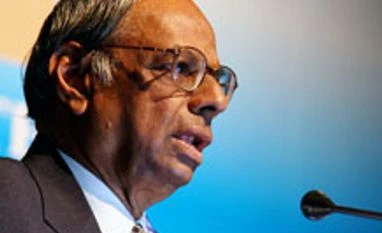 "Govt accepted the principle underlying Committee formula: C Rangarajan")


 Connect with us on WhatsApp