Govt ban on shipping live goats for exports will hurt farmers; here's why

The export of live goats to UAE which typically peaks during Eid-Al-Adha will be the first casualty of the recent ban by the Union shipping ministry
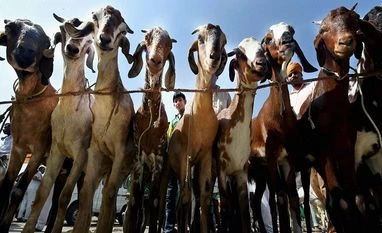
Representative Image
Sai ManishShameen Alauddin New Delhi
Last Updated : Aug 21 2018 | 6:46 PM IST
The export of live Indian goats to the United Arab Emirates (UAE), much prized at Dubai’s cattle market for its delicate meat and sacrifice during the Islamic festival of Eid-Al-Adha (festival of sacrifice), has been booming for the past three years. The trade with UAE, which was virtually stalled since 2009-10 (just Rs 10 million worth of livestock exports) zoomed to touch Rs 3.7 billion in 2016-17, before falling to Rs 2.1 billion last financial year.

But on August 8, a circular issued by the Directorate General of Shipping (DGS) under the Union shipping ministry withdrew an earlier order of the ministry dated August 3 that had laid out specifics regarding the export of livestock, mostly goats to the Gulf in specialised merchant vessels. The DGS circular read: “The permission for certain mechanised sailing vessels to operate during the month of August from ports in Gujarat during the year 2018 is withdrawn with immediate effect.” Curiously enough, the ministry seems to have deleted the August 3 circular from its website. In effect, the export of goats from all ports in Gujarat was stopped just a few weeks before Eid-Al-Adha, a time of booming business for Indian livestock exporters and farmers.

While the shipping ministry did not give reasons for the withdrawal of its August 3 order, reports suggest that the ministry stopped the export of goats from all sea ports in the country citing pressure from animal rights activists. Activist Gauri Maulekhi, whose petition to the Supreme Court led to the framing of stringent cattle slaughter rules in May 2017, told Business Standard: “It is offensive to a vast majority that animals are packed into ships and sent in obnoxious conditions to meet their grisly and slow death in a foreign country after weeks of terrible suffering. The export of live animals for slaughter is against the ethos and the Constitutional mandate of India.”

Asked about the move just weeks before Eid-Al-Adha, Maulekhi asserted: “The timing is irrelevant.” Specific questions sent to the shipping ministry did not elicit a response till the time of publication. The government's decision to ban goat exports from India’s sea ports has political, social and economic consequences.

Politically, the shipping ministry's move seems to have undercut an initiative of the Bharatiya Janata Party’s (BJP’s) Rajya Sabha member Vikas Mahatme, who was actively vouching for the export of goats to the Gulf as a means of supplementing the income of farmers in the drought-affected regions of Maharashtra and Rajasthan. In fact, Mahatme’s initiative had led the government to allow the export of goats via air from the Nagpur airport, consent for which was given by the Union commerce ministry earlier this year. This consent was withdrawn after protests by members of the Jain community in July this year.

Mahatme told Business Standard: “The farmers who breed sheep and goats are totally dependent on them for their livelihood. After a certain point, the only purpose left for these animals is meat. Even in India, these goats and sheep will be used for meat only, but if we would have started exporting to the UAE, demand would have risen, offering an opportunity for farmers to earn more.”

As has been evidenced in the past with respect to buffalo slaughter, any move restricting trade of animals has a negative impact on India’s meat exports as well. What could further hurt India’s livestock industry is that the UAE has emerged as a saviour for India’s goat meat exports over the past few years. Information from the commerce ministry shows that the export of meat of goats and sheep to the UAE has witnessed explosive growth over the past five to six years.

Till 2009-10, Saudi Arabia, Iraq and Egypt accounted for the bulk of India’s global goat and sheep meat exports. With Egyptian and Iraqi markets closed due to increasing political turmoil, India’s goat meat exports, valued at over Rs 7 billion in 2009-10, plummeted by almost 67 per cent in 2011-12. In 2009-10, Saudi Arabia, along with Iraq and Egypt, accounted for more than half of India’s goat meat exports, with a combined value of over Rs 4 billion. By 2011-12, Saudi Arabia was importing more than Rs 1 billion worth of goat meat from India – more than half of India’s total exports of goat meat. In 2012-13, the UAE came into the picture, importing Rs 2 billion worth of goat meat from the country, displacing Saudi Arabia from top. The UAE’s import of Indian goat meat that year accounted for almost half of India’s total goat meat exports. That country’s significance has only grown since. In 2016-17, the export of goat meat to Saudi Arabia touched Rs 5 billion – the highest ever recorded in recent history. This was more than India’s combined exports to other West Asian nations, including Saudi Arabia, Qatar, Bahrain, Oman and Kuwait, and more than half of India’s total goat meat exports worth Rs 8 billion that year.

Economically, the government's move to ban live animal exports form sea ports could hurt India’s livestock exporters at a time of the year when demand for live goats and sheep peaks from Gulf nations, especially the UAE. Reports from the UAE suggest that the price of goats at the Dubai cattle market this year are 65 per cent higher than last year because Indian goats were being transported by air, which is prohibitively expensive. Reports suggest that in 2017, the most preferred Indian and Emirati goats (of the Najdi variety) were selling at the Dubai cattle market for Dirham 3,000 per head (almost Rs 57,000 at prevailing exchange rates). This year, the same variety of goats were reportedly selling for as much as Dirham 5,000 each (almost Rs 95,000 at current exchange rates). Business Standard tried to get in touch with Emirates Livestock & Meat Trading Company, headquartered in Dubai, but could not get a response owing to it being a public holiday on account of Eid.

It’s not the just the UAE which is dealing with high goat prices before the most revered Islamic festival. The negative repercussions on India’s live goat trade could also become apparent in the times to come, especially given the UAE’s share of India’s live goat and sheep exports. Information from the commerce ministry shows that in 2014-15, when the UAE did not import any live goats from the country, India’s total live goat exports were only Rs 690 million – almost all of it to Nepal. In 2015-16 India’s overall live goat exports touched Rs 4.6 billion, of which the UAE alone accounted for Rs 3.4 billion, or 73 per cent of the value of India’s total live goat exports. In 2016-17, India’s live goat exports touched an all-time high of Rs 5.2 billion, again driven primarily by the UAE even though exports to Nepal also increased significantly.

“The export ban will affect the livelihood of over 40,000 families dependent on this trade," news agency PTI quoted Adil Noor, the secretary of the Livestock Association of India, as saying. No wonder then that the Mumbai-headquartered Livestock Exporters Association moved the Gujarat High Court on August 21 against the shipping ministry’s ban on sea transport of livestock outside India. As things stand, by the time the court intervenes, much of the damage would have already been done to this booming trade with the UAE which held great promise not just for India’s exporters but also for the thousands of farmers who were looking to tap the lucrative and underserved Emirati market for live goats.

One subscription. Two world-class reads.

Already subscribed? Log in

Subscribe to read the full story →
*Subscribe to Business Standard digital and get complimentary access to The New York Times

Smart Quarterly

₹900

3 Months

₹300/Month

SAVE 25%

Smart Essential

₹2,700

1 Year

₹225/Month

SAVE 46%
*Complimentary New York Times access for the 2nd year will be given after 12 months

Super Saver

₹3,900

2 Years

₹162/Month

Subscribe

Renews automatically, cancel anytime

Here’s what’s included in our digital subscription plans

Exclusive premium stories online

  • Over 30 premium stories daily, handpicked by our editors

Complimentary Access to The New York Times

  • News, Games, Cooking, Audio, Wirecutter & The Athletic

Business Standard Epaper

  • Digital replica of our daily newspaper — with options to read, save, and share

Curated Newsletters

  • Insights on markets, finance, politics, tech, and more delivered to your inbox

Market Analysis & Investment Insights

  • In-depth market analysis & insights with access to The Smart Investor

Archives

  • Repository of articles and publications dating back to 1997

Ad-free Reading

  • Uninterrupted reading experience with no advertisements

Seamless Access Across All Devices

  • Access Business Standard across devices — mobile, tablet, or PC, via web or app

Next Story


