The government is confident of crossing the disinvestment target of Rs 800 billion for the financial year 2018-19 (FY19). “We may even go up to Rs 850 billion,” said an official in the know.
At present, the total disinvestment is Rs 340 billion. Once Power Finance Corporation (PFC) buys stake in REC, as planned, the disinvestment amount for the year would be Rs 500 billion.
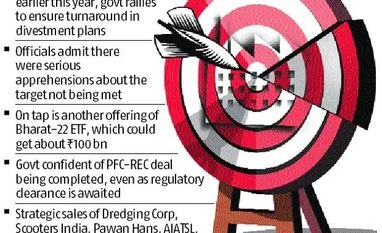
For the rest of the year, the government plans to have another follow-on public offering of its Bharat-22 exchange-traded fund (ETF), which could rake in upwards of Rs 100 billion. It also plans to complete the strategic sale of Pawan Hans, Central Electronics, Air India’s ground handling subsidiary, and possibly Scooters India.
A chunk of disinvestment till now has come from follow-on offerings in the Centre’s two ETFs, Bharat-22 and CPSE. These earned Rs 83 billion and Rs 170 billion, respectively.
Now, there will be initial public offerings of Mazagon Docks, rail companies RVNL and IRFC (in which 10 per cent each will be divested), and MSTC. Then there are state-owned companies buying back shares.
Senior government sources said buybacks by public sector units could get the exchequer between Rs 120 billion and Rs 150 billion. There could also be the offer-for-sale of general insurance companies GIC and New India Assurance.
Top sources in the government also said the Centre was still trying to push through the acquisition of its stake in SJVN by NTPC, valued at Rs 70 billion.
The Cabinet has already cleared the selling of “enemy shares”, currently with the Custodian of Enemy Property for India (CEPI), in 996 companies, and gave its nod to the government divesting its entire stake in Dredging Corporation of India (DCI) to a consortium of four ports. These two could add around Rs 30.7 billion to the disinvestment kitty.
All this of course adds to PFC-REC deal. “We are hoping for a decent premium on the deal. Anything around Rs 150 billion will be good for us,” said an official.
The deal between the two power sector non-banking financial companies will be the single biggest disinvestment move of the year and will require regulatory approvals from the Reserve Bank of India, the Securities and Exchange Board of India, and the Competition Commission of India.
Officials in the department of investment and public asset management (Dipam) are confident regulatory hurdles will be cleared and that the deal will be completed on time.
“There was a lot of apprehension within the government on whether the total target will be met or not, especially after the planned privatisation of Air India found no takers. As things stand, various departments have come together to work out alternative routes and the political leadership has backed these plans. We could exceed Rs 800 billion,” said a second official.
If the proceeds this year do exceed the target, this would be in line with Finance Minister Arun Jaitley’s statement in September. After a meeting at Prime Minister Narendra Modi’s residence to take stock of the economy, Jaitley had said the Centre will stick to its fiscal deficit target of 3.3 per cent of gross domestic product without cutting capital expenditure, in spite of an anticipated shortfall in the goods and service tax.
This would be partly balanced by the direct tax and disinvestment budgeted targets being exceeded, Jaitley had said.
In 2017-18 as well, disinvestment proceeds had exceeded the target, though by a substantially larger degree. Against a budgeted estimate of Rs 725 billion, Dipam raked in a record Rs 1 trillion. A big portion of that was ONGC’s acquisition of Hindustan Petroleum, which garnered Rs 396 billion on its own for the government, and took Dipam to a record disinvestment realisation.

 "Govt confident of crossing disinvestment target, hopes to garner Rs 850 bn")











