The government, on Friday, announced a new exchange traded fund (ETF), comprising stocks of 22 state-owned companies, public sector banks (PSBs), and private sector companies in which the government owns substantial stakes.
The new CPSE ETF, named Bharat-22, draws companies from six sectors. The constituents of the basket are Nalco, ONGC, IndianOil, Bharat Petroleum, Coal India, State Bank of India (SBI), Axis Bank, Bank of Baroda, Rural Electrification Corp, Power Finance Corp, Indian Bank, ITC, Larsen & Toubro (L&T), Bharat Electricals, Engineers India, NBCC (India), Power Grid Corp, NTPC, Gail (India), NHPC, NLC India (formerly Neyveli Lignite), and SJVN.
The instrument, which is the government’s second CPSE ETF, will have a diversified portfolio of six sectors such as energy, fast-moving consumer goods, finance, basic materials, industrials and utilities, Finance Minister Arun Jaitley told reporters at a media briefing. This compares with 10 stocks in the first CPSE ETF, launched in early 2014, and drawing mostly from the energy space.
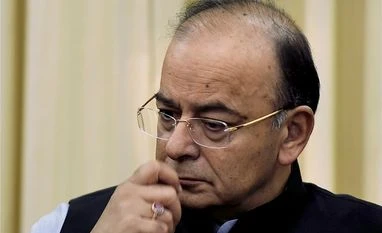
“While selecting each of these sectors we have kept in mind sectoral reforms which have had direct impact on the valuation of these shares... We believe that this ETF will be a fairly successful one,” Jaitley said.
The stocks with the highest weight in the ETF basket are L&T (17.1 per cent), ITC (15.2 per cent), SBI (8.6 per cent), PowerGrid (7.9 per cent), Axis Bank (7.7 per cent), and NTPC (6.7 per cent). The other stocks have weights ranging from 5.3 per cent to 0.2 per cent. The Centre holds minority stakes in Axis Bank, L&T, and ITC through the Specified Undertaking of Unit Trust of India (SUUTI).
Jaitley and Department of Investment and Public Asset Management Secretary Neeraj Gupta did not specify any date as to when the new ETF would hit the bourses. Gupta said there was no upper limit on funds that could be raised through an ETF.
“The ETF’s units will be issued in different tranches as per requirement of the government,” he said. The first tranche will be a new fund offering, followed by follow-on offerings.
The Centre is pitching Bharat-22 as a diversified offering, with exposure to six sectors, ensuring spreading of risk and diversification. It hopes that the ETF will provide better returns and yields not just compared to the first CPSE ETF, but also compared to other ETFs.
Jaitley said the inclusion of three state-owned banks in the new ETF was “consistent” with government policy. “The government’s stake can go down to 52 per cent in PSBs and whenever possible, we will look for possible consolidation,” he added.
The asset manager of the new ETF is ICICI Prudential Asset Management, with advisers being Kotak Mahindra Capital Co.
The first CPSE ETF was launched in March 2014. It is managed by Reliance Mutual Fund and has so far garnered Rs 11,500 crore for the exchequer in three tranches. A fourth tranche is expected later this year.
An ETF is a security that tracks an index, a commodity or a basket of assets like an index fund, but trades like a stock on an exchange. It provides diversification to investors and is cheaper than investing in a fund.

 "Govt forms Bharat-22 ETF for asset sales in 22 firms; to cover six sectors")












