In line with the thinking that gold should be looked upon more as a currency than a commodity, the government and the Reserve Bank of India (RBI) are considering gold-based savings products, for which returns would be with reference to gold, but with no need to purchase the yellow metal.
Decisions on gold would be in accordance with this, said people familiar with policymaking. This is being done to retain the attractiveness of gold as an investment vehicle.
The move follows the finance ministry’s decision to relax the sovereign gold bond scheme. Now the RBI has more powers to issue bonds with greater flexibility, and, as part of that, a few schemes may be announced before Diwali if work on it is completed.
Or else the schemes may be announced in the first week of November, when the gold scheme completes two years.
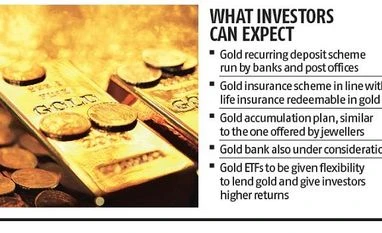
The RBI and the government are looking at several investment options such as gold recurring deposit schemes, similar to the ones offered by banks and post offices. Other options under consideration are floating a gold insurance scheme, and setting up a gold monetisation company or bullion bank. Of these, financial products are under consideration while the bullion bank proposal is being looked into by a panel set up by the NITI Aayog.
According to sources, there is a proposal to make gold exchange-traded funds (ETFs) attractive. ETFs will be allowed to lend gold to jewellers and part of the returns from lending will be passed on to investors.
It was felt that ETFs are required because they have more liquidity than exchange-listed sovereign gold bonds.
However, ETFs have to buy physical gold equivalent to the investment and hence they shall be given the flexibility to lend gold, which can replace import to an extent.
So far as gold’s role as a commodity is concerned, it will remain confined to domestic jewellery and promoting its exports, sources said.
In the jewellery export market, India’s share is negligible. The government will be interested to know where gold is moving and whether it is generating black money or there is genuine demand.
On August 23, the government brought jewellers under the Prevention of Money Laundering Act, requiring them to comply with stringent norms.
Sudheesh Nambiath, lead analyst for South Asia, GFMS Thomson Reuters, said: “Such a measure is nothing but recognising the fact that Indian policymakers are in agreement with the view that gold is equivalent to a currency and not any other commodity. This may also mean the government could consider streamlining trade flows in such a way that they provide transparency and effective monitoring.”
Now gold may be treated as a currency or commodity. From the trading perspective what is taken out of the vault is a commodity and what remains with the exchange is a currency. This was also explained to government officials when presentations on the spot exchange was made. Now industry representatives have also started talking in terms of gold as a commodity or currency and there is general agreement that precious metals must be treated differently from other commodities.
Surendra Mehta, national secretary, Indian Bullion & Jewellers Association, said: “When the transformation of the gold market is considered by the government, it is also essential to debate whether gold is a commodity or currency. This is due to the fact that all commodities except gold can be destroyed.”
As a currency, the annual average gold price in the last five-six years has moved in a very narrow range except on one or two occasions.
Until 1917, gold was used as money. This role, or the gold standard, ended after that though gold still behaves like money on occasions.
The gold market is more liquid than the bond or currency market and it is a tangible asset because its supply is elastic. Unlike currencies, it cannot be printed and hence preserves its purchasing power. That is why it acts as a safe haven during financial turmoil. It’s bought when trust in central banks and governments diminishes. Ironically central banks buy and hold gold as a diversification.
In India, so far as its use as a commodity is concerned, a NITI Aayog sub-committee recently discussed good delivery standards, which will help exporting the gold refined here. The committee also discussed if India’s share can be increased in the jewellery exports market.
According to industry experts, if India set up its good delivery norms and the proposed gold spot exchange provides transparent prices, India will have a say in gold price setting.