Govt spending in FY17 likely to be revised down: Credit Suisse

The government has likely taken the move in order to meet its fiscal deficit target of 3.5%
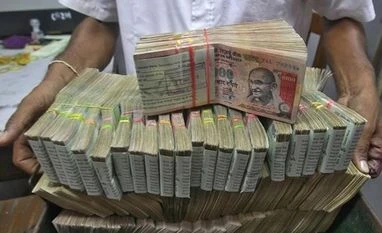
Photo: Reuters
An employee poses with the bundles of Indian rupee notes inside a bank in Agartala, the capital of Tripura. Photo: Reuters
Ishan Bakshi New Delhi
Last Updated : Jun 02 2017 | 1:55 AM IST
Estimates of gross domestic product (GDP) released by the Central Statistics Office (CSO) showed government spending grew a staggering 39.1 per cent in the fourth quarter (Q4) of FY17. 

This estimate of spending (Centre and states) might not be based on full financial year data, say analysts at Credit Suisse in a new report. Rather, it is possibly based on data for only10 months.

The report estimates combined spending by Centre and states was actually lower by Rs 2.6 lakh crore or 1.7 per cent of GDP. Of this, roughly Rs 2.2 lakh crore was due to lower spending by states, with the balance being on account of the Centre. 

With non-tax revenue short of expectations, the government has likely pushed an estimated Rs 40,000 crore of spending to April 2017 to meet its fiscal deficit target of 3.5 per cent says the report. 

While the report suggests this shortfall has not yet been accounted for in the latest GDP estimates released by the CSO, others aren’t convinced about the impact on headline GDP growth.  “The bottom-up production-side estimates (namely agriculture, industry, services), aggregating to gross value added at basic prices, and then feeding into the headline GDP metric, tend to be relatively robust, albeit subject to some revisions as additional data become available,” said Aditi Nayar, principal economist at ICRA. “The headline GDP is disaggregated top-down into various expenditure components, for some of which quarterly data is not available in a timely manner.” 

Adding, “While paucity of data on central and state government expenditure for the entire quarter may have contributed to an overestimation of growth of government final consumption expenditure (GFCE) for Q4, in our view, availability of additional data could result in a lowering of GFCE growth, as well as an adjustment of the discrepancy figure. We do not anticipate that the lowering of GFCE growth would dampen the headline GDP expansion for Q4 to the same extent.” 

Discrepancies on the expenditure side of the data is a residual entry that remains after the CSO disaggregates the GDP from the production side into its expenditure components, such as private and government expenditure and investment.

One subscription. Two world-class reads.

Already subscribed? Log in

Subscribe to read the full story →
*Subscribe to Business Standard digital and get complimentary access to The New York Times

Smart Quarterly

₹900

3 Months

₹300/Month

SAVE 25%

Smart Essential

₹2,700

1 Year

₹225/Month

SAVE 46%
*Complimentary New York Times access for the 2nd year will be given after 12 months

Super Saver

₹3,900

2 Years

₹162/Month

Subscribe

Renews automatically, cancel anytime

Here’s what’s included in our digital subscription plans

Exclusive premium stories online

  • Over 30 premium stories daily, handpicked by our editors

Complimentary Access to The New York Times

  • News, Games, Cooking, Audio, Wirecutter & The Athletic

Business Standard Epaper

  • Digital replica of our daily newspaper — with options to read, save, and share

Curated Newsletters

  • Insights on markets, finance, politics, tech, and more delivered to your inbox

Market Analysis & Investment Insights

  • In-depth market analysis & insights with access to The Smart Investor

Archives

  • Repository of articles and publications dating back to 1997

Ad-free Reading

  • Uninterrupted reading experience with no advertisements

Seamless Access Across All Devices

  • Access Business Standard across devices — mobile, tablet, or PC, via web or app

Next Story



