It is not every day that the mad bustle that is the New Delhi airport gets a chance to upstage the swank sophistry of Changi, Singapore or sit at the same league table as the Heathrow, London. Except when it is on social media platforms: the Indira Gandhi International is the first among Asian airports and on the list of top five globally on Twitter with a similar ranking (a few notches up and down) on other platforms too. Even as it grapples with the rising swell of fliers and aircraft on the ground, IGI is learning to play by the rules of the social media jukebox; swinging to the beat of the millions that walk through its gates and not just the airlines that ply its runways.
"Our strategy is to serve three key objectives -- Online Reputation Management (ORM), Customer Response Mechanism (CRM) and Brand Building. In other words, humanise the customer experience by engaging with our flyers digitally. This is what we are doing for 365 days a year, for the last six-and-a-half years," says I P Rao, CEO, Delhi Airport, part of the GMR Group.
The public is social
Social media has changed the way people interact with public spaces. Airports are doubling up as shopping malls with restaurants, spas and a bunch of other things. Passengers are not just in to board a flight, they browse, record their experiences and chatter about the facilities (or the lack of) on social media. An airport cannot afford to not be a part of their social network. At last count, there were over 60 million passengers travelling through Delhi Airport, the majority on some social platform or the other—talking to friends and the authorities for help, complaints and any other issues.
Rao says: “Airports are more than standalone aviation infrastructures. They are now multi-modal, multifunctional enterprises, like a mini city with all the conveniences.” The social media team at the Delhi airport has been focused on building a brand that understands the new social mores. And on February 13, 2018, it led the Asia table on Twitter with 78,658 followers, Changi had 72,895 and RGIA, Hyderabad had 62,178. It still has a long way to go on the global scale, but it is among the top five in a list headed by Heathrow Airport with 4,69,083 followers.
Sanjiv Kapoor, Vistara’s chief strategy and commercial officer, says: “It shows that they are taking social media seriously and we are very happy for that. It is important. For example, if there is a fog in the airport, not only the airlines, but also the airport can inform the customer proactively. It is good to have other stakeholders visible and accessible to the public.”
Engaging with passengersFollowers alone do not make a social media star, response time to complaints and the ability to engage with passengers, be it to guide them through the facilities or to provide them with necessary information, matter as much.
For the Delhi airport, Rao says, response time is 30 minutes for direct complaints and 45 minutes for indirect complaints received via social media. Apart from swiftness, he says, the responses are personalised and humane. And this is despite the fact their team is smaller when compared to Changi and Schiphol (Amsterdam) airports.
B Govindarajan, chief operating officer, Tirwin Management Services said that airports are leaving nothing to chance to be customer (airlines) and consumer (passenger/users) friendly. “Airlines can be attracted by lower tariff, more aircraft parking slots, faster baggage in-line screening etc., for passengers they focus on shopping and information,” he says. Klout, an online social media analytics and ranking platform that looks at a number of indicators, has placed the Delhi airport on top in Asia Pacific with a score of 74 out of 100 and third globally where Los Angeles Airport tops with 88 points.
The shop-and-fly experience
At the airport, the content buckets are broadly divided into Shop, Eat, Relax and Fly. Besides the advisories and assistance required for emergency situations. The social media team also tracks celebrities and human interest stories to keep passengers engaged. Tirwin says, “People use social media is to know the availability of select products and its price in the airport duty free shops.” The airport has become a mall that caters to diverse interest groups.
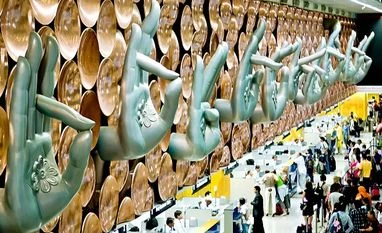
Celebrity spotting is another big draw on social media. The Delhi airport handle regularly posts images of celebrities passing through its portals; PV Sindhu posing next to the Sun God statue, Saina Nehwal enjoying the Christmas décor and Bollywood star Kareena Kapoor just outside T-3. It means that the social media team has to be on its toes, with an eye out for every opportunity stepping its way night and day. After all an airport never sleeps, not on the ground and not on social media either.
Every airport has a special feature that pushes it up the charts on social media. While the New Delhi airport has been commended for its swift and personalised responses, here is what some others are known for:
Singapore, Changi: Great offline-online integration and their passengers are their online ambassadors. Strong on Facebook, where they regularly showcase promotional activities
Amsterdam, Schiphol: Big on communicating in the native language. Most traction received on their pages pertains to the posts where they're communicating in Dutch rather than English
London, Heathrow: Personal connections with passengers high

 "How Delhi Airport upstaged Changi with a starry turn on social media")











