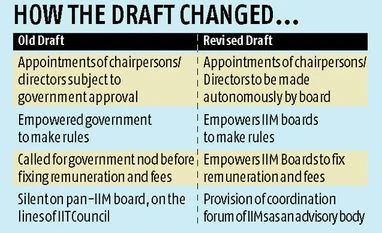
The Indian Institutes of Management (IIMs), the old and the new ones, might see less disparity in the way they are managed if the revised draft Bill on them is any indicator.
The IIMs have not taken a look at the draft, which is yet to be presented in Parliament.
However, IIM directors Business Standard spoke to say that unlike the current structure, in which the older ones can constitute their boards, while the newer ones have a high degree of government control, the new Bill is likely to bring in greater uniformity in the process.
IIMs, directors say, have been “informally” told that they would not get access to the document until it is presented in Parliament.
However, according to sources, the revised draft not only allows the board to manage the appointment of chairpersons and directors but also empowers it to select its members.
“Only few IIMs have active societies, which roughly manage the institution through the board, while the rest, especially newer ones, are indirectly managed by the government. The Memorandum of Association (MoA) varies from one IIM to another. The older IIMs like Ahmedabad, Bangalore and Calcutta are able to relatively govern themselves, while a lot of others are governed by the government. However, from what we hear, according to the revised Bill, this could bring in uniformity among the IIMs,” said the director of a newer IIM.
According to the director of an old IIM, after a government nod in the United Progressive Alliance regime in 2012 for a modified MoA, the IIMs were empowered to trim the board size from more than 26 to 14, appoint their alumni on the board and decide the pay structure of the staff and faculty independent of pay commissions. The changes were on the basis of the recommendations of three committees — one each on governance, faculty and funding — constituted in 2010.
However, with most of the newer IIMs depending on government grants, they ended up being less autonomous, with the government overseeing their managements.
“We have been given to understand that the board will have its own sub-committee under a uniform MoA, which takes care of nominations whenever a member’s term gets over. Instead of the ministry getting involved, it is a board-run administration. The ministry’s guidance will be there but the board will manage the process. The understanding is that there will continue to be a central and state government representative on the board,” the director of another IIM said.
IIMs are waiting for clarity on the coordination forum, as provisioned in the revised bill to act as an advisory body. “How it will be formed will be clear when the draft is made public,” said a director.