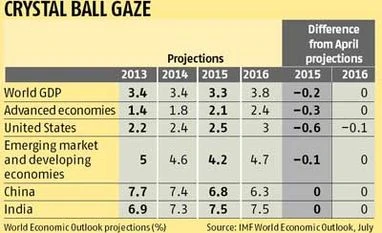
The International Monetary Fund (IMF) on Thursday reaffirmed its growth forecast for India in its latest World Economic Outlook (WEO), pegging growth at 7.5 per cent in both 2015 and 2016. Earlier, the World Bank too had projected India to grow at 7.5 per cent in 2015.
With China expected to slow down considerably, the IMF pegs its growth at 6.8 per cent in 2015 and 6.3 per cent in 2016, the gap between the two countries is likely to widen to 1.2 percentage points by 2016.
In its latest WEO, the IMF lowered its forecast for global growth, indicating the fragile state of the world economy. It has pegged global GDP growth at 3.3 per cent in 2015, lower than its April outlook of 3.5 per cent. Though in 2016, it expects growth to bounce back to 3.8 per cent.
Outlining its thinking on these growth projections, the IMF said that the “projected pickup in global growth, while still expected, has not yet firmly materialised,” adding that, “raising actual and potential output through a combination of demand support and structural reforms continues to be the economic policy priority.”
Growth in advanced economies is estimated to increase from 2.1 per cent in 2015 to 2.4 per cent in 2016. The IMF notes that this gradual pickup in advanced economies is largely due to the unexpected weakness in North America. But, making a case for a stronger bounce back, it said that the “underlying drivers for acceleration in consumption and investment in the United States — wage growth, labour market conditions, easy financial conditions, lower fuel prices, and a strengthening housing market — remain intact.”
On the uncertainty in the Euro zone, the IMF is surprisingly sanguine. It has revised its growth projections upwards for many euro area economies, noting that “developments in Greece have not till now resulted in any significant contagion.” Although, it adds that recent developments in Greece could weigh down heavily on the economy.
But the downside risks to growth remain; principal among them being a quick reversal of capital flows from emerging economies. The IMF notes that “disruptive asset price shifts and a further increase in financial market volatility remain an important downside risk,” adding that, “such asset price shifts also bear risks of capital flow reversals in emerging market economies.”
During times of turmoil, capital tends to flow towards safe havens such as US treasuries, thereby strengthening the dollar. Given the uncertainty over Greece, the ongoing stock market shakeup in China and the possibility of an interest rate hike in the US, capital could quickly flow out of emerging economies like India.
This, as the IMF notes, “poses risks of balance sheet and funding risks for dollar debtors, especially in some emerging market economies.” As reported in Business Standard, aggregate debt of India Inc stood at Rs 28.7 lakh crore in 2013-14, of which Rs 4.5 lakh crore was dollar denominated. A substantial chunk of this dollar denominated remains unhedged. Thus, a quick reversal of capital flows could affect these companies.
On the whole, the IMF expects emerging markets and developing economies to slow down from 4.6 per cent in 2014 to 4.2 per cent in 2015.

 "India's 7.5% growth spurt in 2015 & 2016 to surpass China's")

