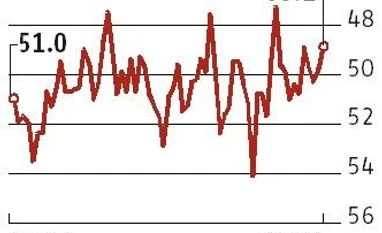
New business orders, employment push manufacturing PMI to 53.1 in October

Manufacturers stepped up hiring in October, and job-creation during the month was the strongest since last December
chart
Indivjal Dhasmana New Delhi
Last Updated : Nov 02 2018 | 8:10 AM IST
Manufacturing activity in October, spurred by domestic demand, were of the level of June, the highest this calendar year, according to the widely tracked Nikkei purchasing managers’ index (PMI). 

The PMI rose from 52.2 in September to 53.1 in October. A reading above 50 is expansion and one below it is contraction.

June also saw the PMI at 53.1.

New orders increased sharply in October and companies responding to the PMI survey attributed this rise to advertising efforts and underlying demand. The rise in new order flows has been the fastest since June.

“A combination of domestic and foreign orders fuelled the upturn in overall activity. Although export orders displayed the slowest expansion since July, new work rose at the sharpest pace since mid-year," said Pollyanna De Lima, principal economist at IHS Markit, which compiles the PMI, and author of the report. 

The upturn in exports cooled in October. If these translate into official figures, merchandise exports would again come under pressure after declining in September. The upbeat October PMI will not be captured in the official GDP figures for the second quarter, which would be released by the end of this month. 

The GDP figures and PMI do not necessarily move in tandem.

Manufacturers stepped up hiring in October, and job-creation during the month was the strongest since last December.

Notwithstanding the fact that Indian manufacturers were confident that output will be higher next year and they increased their marketing activity and investment, concerns about market conditions dampened the optimism.

“Producers of goods see challenges and uncertainties ahead, which in turn translated into the weakest degree of optimism seen in 20 months,” Lima said.

There was inflationary pressure amid reports of higher prices of chemicals, energy and metals. The average cost burdens increased and some manufacturers passed part of the additional cost on to their clients.

However, the rate of selling price inflation was mild, in the context of the historical survey data, the PMI report said.

One subscription. Two world-class reads.

Already subscribed? Log in

Subscribe to read the full story →
*Subscribe to Business Standard digital and get complimentary access to The New York Times

Smart Quarterly

₹900

3 Months

₹300/Month

SAVE 25%

Smart Essential

₹2,700

1 Year

₹225/Month

SAVE 46%
*Complimentary New York Times access for the 2nd year will be given after 12 months

Super Saver

₹3,900

2 Years

₹162/Month

Subscribe

Renews automatically, cancel anytime

Here’s what’s included in our digital subscription plans

Exclusive premium stories online

  • Over 30 premium stories daily, handpicked by our editors

Complimentary Access to The New York Times

  • News, Games, Cooking, Audio, Wirecutter & The Athletic

Business Standard Epaper

  • Digital replica of our daily newspaper — with options to read, save, and share

Curated Newsletters

  • Insights on markets, finance, politics, tech, and more delivered to your inbox

Market Analysis & Investment Insights

  • In-depth market analysis & insights with access to The Smart Investor

Archives

  • Repository of articles and publications dating back to 1997

Ad-free Reading

  • Uninterrupted reading experience with no advertisements

Seamless Access Across All Devices

  • Access Business Standard across devices — mobile, tablet, or PC, via web or app

Next Story


